Showing posts with label georgian. Show all posts

Sunday, 19 October 2014

Fairfax project 1750s

New week, new task. Travelling back in time ( wibble wobble, wibble wobble) to 1750 or there abouts.  Location Fairfax House o Castlegate, York.  Minor difficulty is that the house was built 5 years into the future, but the portrait I'm taking inspiration from did exist, and hung and currently hangs there.

Hope that is clear.


in situ in her bedroom
The portrait is of Anne Fairfax is dated 1750, showing her as a young lady shepherdess. ( quite a common conceit  - see It's About Time for more imagery.)  Lady Anne was the only surviving daughter of Charles, 9th Viscount Fairfax of Emley  and the house was built for her. The painting  hangs in her bedroom facing the bed and she apparently was very fond of it.
The painter, a French artist who worked extensively in England, is Phillip Mercier. He lived in York for a time, painting many of the society ladies.  
 The painting is very whimsical, but I think I quite like it because it raises questions,   the rose at her breast is rather odd - painted differently, and there is a mystery orange line across her chest, plus one of the sheep looks like a neighbour, but it will do as the start point for a costume task.  I would like to recreate this - or something based on it. ( If it goes well in diddy scale  it might get made full size!) 


quick initial sketches and notes

The painting does pose some problems - it was about her and the allegory, not her dress. The two sleeves are different - one fits smoothly at the shoulder but the other is gathered into pleats, there is a faint line down the centre forn suggesting  a seam or an opening, but the brush work at the junction of bodice and skirt is so loose it is going to be interpretation and best guess. My assumption is that the dress is conventional, a closed bodice over a full skirt. The closest example I have found so far is the 1780 wedding dress from the V&A exhibition to the left. The low scooped neck, tight bodice and pleated skirt are what I am imaging. Just 30 years difference.

But the current question is really about the fabric. It shines so must be satin or silk, but it looks much softer in the creases and on the surface than the pink drapery, so it can't be the same as that. Could it be fine velvet?  I took some samples of satins and silks in to compare with the painting and remained unconvinced by any of them.

While all of this is happening I have not been idle - much.  I am now in possession of a 12 inch artist's mannequin and am trying to make the underwear to fit. It is currently nameless.

Progress  so far has been good, 'she' has  a chemise - with gussets!, an approximation of stays, and even pocket panniers.

The chemise is to an C18th pattern, the standard issue, rectangles and underarm gussets (- much the same as the blue print used for gentleman's shirts)
very masculine....


The stays were more of a challenge - boning, binding and eyelets! The boning I will admit to being narrow cableties, The binding is the smallest I could make, and the eyelets - I know they should have been hand done but.... so they are just what I had and are completely huge!  The first try was agonising but these ( version 2) went together quite simply.
The stays are really so that I could alter the shape of the torso - widening at the top and narrowing at the waist to the C18th cone shape. This is partially sucessful so more padding may be needed. Added padding to the upper back as well as bust  and it has made such a difference- happier now. 
They could do with more tabs at the waist but that will have to happen on the next ones.  

To give the exaggerated hips I decided on pocket hoops/panniers - small cages either side rather than the full width one more associated with formal or court dress. The discussion was whether to go for bum pads but actually wanted to try out the panniers! Umm.

They were based on a pair on display in the 'Head to Toe, Accessorising the Georgians' exhibition currently on at Fairfax House. Although fiddly at this scale they were fairly straightforward- channels were made in the outer panel, one side of the inner panel was attached, the bones slotted in and the other side seam made.

That the inner panel is narrower than the outer gives the tension to create the required curve. The top is pleated  to fit to the waist and sewn onto a band. Simple!

The overall silhouette is an improvement- would still like to pull the waist in more - the contrast between waist and hip should increase anyway as the petticoats are added so this is not crisis thinking yet.

Wonder if I would warm to her if she had hair?
Definitely lacks personality at present. Any suggestions for a name?

You never know - might have tidied up by next week.


Sunday, 11 May 2014

Hogarth, Gwen and the Bedgown


When is a bedgown not a bed gown? When it is a bedgown of course! Shortgown or "Manteau de Lit", or occasionally a casaquin or caraco  ( still haven't sorted out the names of things).


1741 Hogarth painting of Elizabeth Betts. Just what is she wearing? It looks to be a silk crossover gown, simple straight neckline, odd creases at the shoulder and worn over a chemise. The sleeves are folded back, unlined, showing the lace on the chemise cuffs. I posted this in a couple of facebook groups and the consensus was either a deshabille garment, an old robe a la francaise being used for lounging-around-at-home, or a length of fabric draped on her by the artist.  

We went for the deshabille option. What a mistake! Life would have been so much easier if the artist drapery came out on top!
 
 
So research.... in trying to find deshabille examples I came across the bedgown, such a general term that all sorts of garments, functions and fabrics came into range, and the crossover was one of the fastening options.
Both from Phillip Mercier
The definitions I have found agree that it is an informal loose coat/bodice very simply made out of one block of fabric. Diderot describes them as a "kind of short clothing which the women wear to the bed, and which they keep in the morning in the fashions of 'deshabille'. "  This was the posher version, silk, fine cotton or linen, often lined and pretty. (What I would know as a dressing gown?)
Just to confuse me, the name was also being used for the common practical work clothing of most women, the shortgowns. These are everywhere in the images showing the working classes - the print after J Collett has the old hag in one.  I guess the same structure of garment was used but made from hard wearing fabric, even wool for warmth. These were not so pretty, often crossed at the front and held in place by tying the apron over the top as in the Sandby sketch.
This seems to be a very versatile garment, adaptable enough not to be out of place in any company; it could be worn by all, made of any fabric, plain or embellished, work wear or for casual home wear. The extant ones labelled “bedgown” seem to be a motley lot, some are more complex, some have drawstring waists and the neckline appears to be personal choice. The problem may be that the name started as a description of the function and then broadened to cover any similar garment.
 
 
Like all the best things the design is logical and economical and adaptable enough to be long lived – think maybe of 18th century denims or tee-shirts? The KCI cites the influence  of imported of Japanese kimonos. These had been in demand as men's wear but were in short supply so other sources were found – like the banyan from India, popular in England.   Made from one length of fabric folded and cut into a 'T', with a centre front cut for the opening. There are no set in sleeves, and only the minimum of seams and fuss.
 
  There are several patterns, modern interpretations and original versions, available. Most have the fabric folded at the shoulderline and the basic shapes cut out of the front and back together, some show it folded side to side as well so the complete garment was cut in one go- half the measuring and quick. The shape was modified with pleats at the back and hip, or flaring skirts, with some having underarm gussets as well. Necklines could be left as the single cut or shaped as desired, and the off cuts used to extend the sleeve or as a cuff.
I even tried imagining the next part of the painting  as if it was a bedgown -  seems feasible. (why does she look so worried?)
 
Now being utterly frustrated and made cross eyed by the circular and warm fuzzy nature of the research, it was time to make....


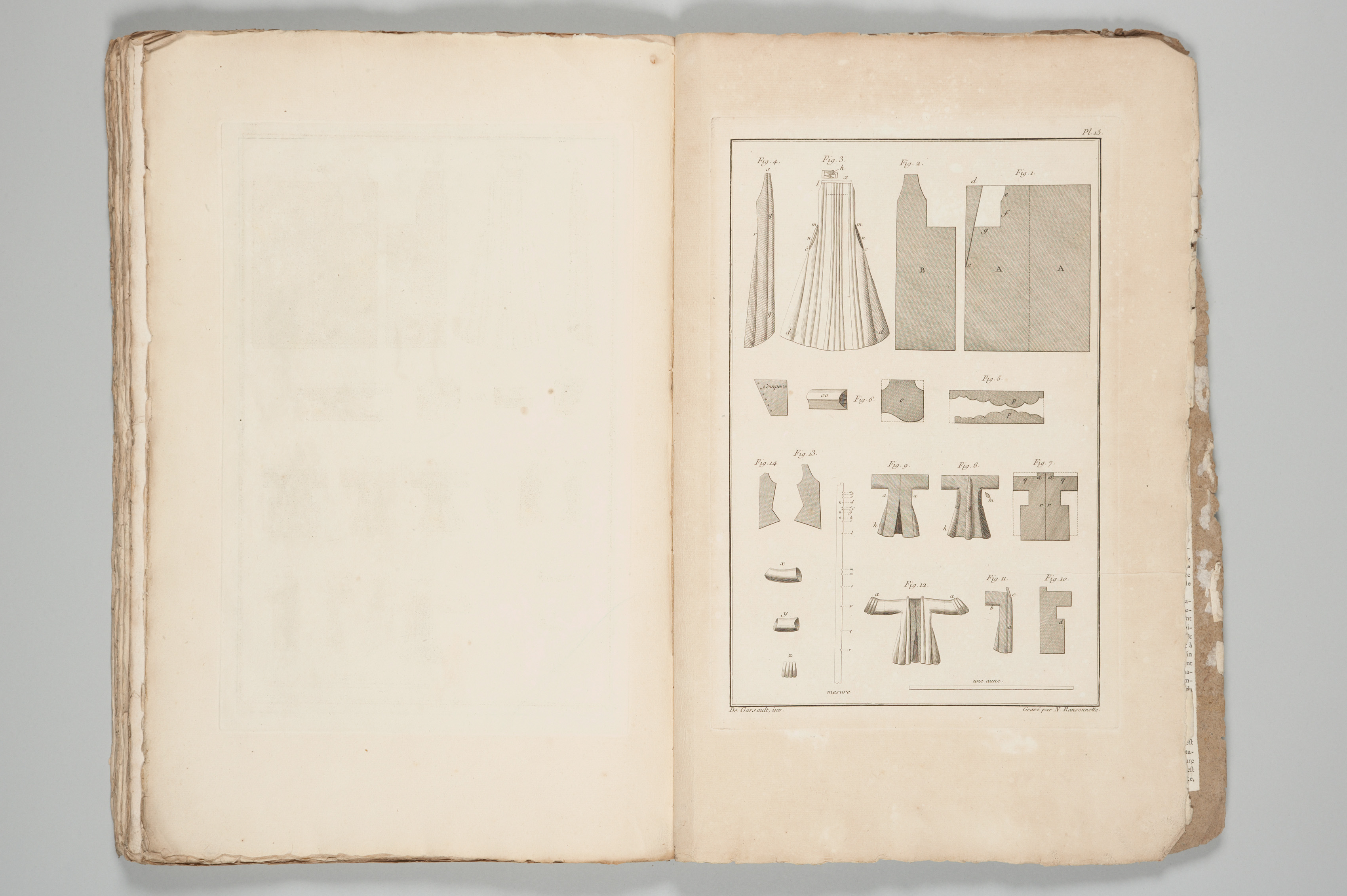
My starting point will be instructions and illustrations from the classic document - Garsault's L'art du tailleur, published in  1769. ( the whole book is online courtesy of Bunka Gakuen Library.)  I followed it as fig 10- the cutting outline, fig 7 - the cut fabric,  fig 8 - the inside back showing centre pleat and side pleats in place, fig 9 - the front assembled, fig 11 - creating the collar and 12 shows the completed coat.
 
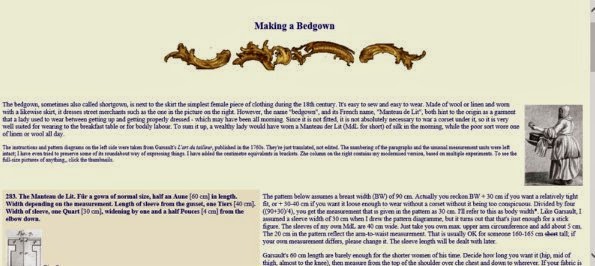
Fortunately, having tried to read a little of the original I found a real life line -  it does everything I wanted to, does it clearly and with pictures! and it's called " Making a Bedgown".
    
Marquise - making a Bedgown
 
 
  She has set out her interpretation alongside a translation of Garsault, phew indeed. Mine will be based on his description but not try to follow it exactly. Even the initial layout is a slight variation, he begins with his shoulder fold above half way – cuts the front opening up beyond the half way point to the back of the neck opening,  then re folds on the half way mark to cut the sleeve and bodice shapes. I cheated - marked halfway up the fabric length and then simply cut the opening to 2 or 3 centimetres beyond it, did the back neck cut and then folded.
The image shows the shapes drawn up on a scrap of fabric- not exactly a 'muslin' but it was a trial piece to check proportions and placement.  Red is for cutting, blue is the shoulder fold, yellow the back and side neck cuts.
Construction was very straightforward – a back box pleat from neck to waist - would allow for ease and arm movement ( if Gwen moved, or had arms) – one line of stitching. The neck had to be widened again to allow for this and the extra cuts back to the shoulder line were made then.

The most evil part was next – gussets under the armpits- Garsault calls the wedges?- I have lived most of my life in blissful ignorance of these things but no more. What was worse I wrestled them into submission and then decided to undo and reduce in size. To try to develop some empathy they are now called Horace (been reading Pratchett again).
 
There is one in there somewhere - the new game of spot the Horace.

 
I left the full width of the fabric on the skirt to make the hip pleats, so having sewn the skirt seams then folded the excess into double box pleats and sewed them in place. Fairly standard practice.  The front edge was folded back on itself to make a false robing ( G says pleats) and a small section added across the back of the neck to complete the shawl collar. The offcuts from under the sleeve were pieced and added to extend the sleeve.
 
  Hemmed it and it is done!  At its most simple this is a very easy and quick sew. Nothing fancy at all, and it gives a robust, useful  short robe. No exceptional skills or precise fitting were required so no wonder that it was so popular as workwear. The cutting layout is so straightforward and economical it would appeal to anyone on a budget. But....  Then added cuffs. Then played with fastenings, and removed them again. Then thought about aprons. Then set up a la Hogarth.                                            Why does finishing take as long as starting? It should all be downhill by now.
 
The gown feels quite alien in a way. Everything else has had to be fitted – even the sack backed pet en l'air had a tightly laced bodice lining underneath. I think mine is just a bit too long (stand Gwen on a box was the first response to that one). The fabric mix is a bit off – they are both from the pillowcase stash- but actually work very well together in black and white, hence the pencil study ( a la Ingres). 
 
  In most of the photos it is pinned or belted - and does look a bit like maternity wear, so when trying to match Hogarth's   I pinned some ties at the waist and pulled hard. Surprisingly the pulls and creases are very alike.


Key questions of the week – what was a bedgown ?   and could this have been the garment in the Hogarth painting?
 
Well I could hazard an answer to the first one but with all the usual quibbles about there being no single definitive answer that covers all eras, countries, functions.
 
As for the second -1741- were these around then? Garsault published in 1769 so they must predate then. One site said not before the 1760s, and a couple of the American ones point out how difficult it is to date or attribute accurately. These were not the kind of garments that were preserved or documented extensively. I like the practical evidence though - the pulls at the waist are horizontal and follow the same pattern as in the painting without any tweaking.

The honest answer to the second question will have to be – maybe.

 Hogarth - BBC paintings-  http://www.bbc.co.uk/arts/yourpaintings/
http://digital.bunka.ac.jp/kichosho/file/No.225/225-0000-048.jpg

Sunday, 27 April 2014

Georgian Jacket, caraco, pet en l'air, bodice......

Georgian Jacket - the French Revolution  Dress crossed with the Chocolate Girl.

Somewhere along the way I  acquired a pack from the Northern Society of Costume and Textiles about a dress  displayed at Castle Howard in the 90s.  The linen dress had been worn ( as a disguise!) by the widow of the Comte Guillaume de Panthou, wife of Henry Seymour, to escape from Paris at the time of the Revolution. By that time it was second/third hand, owned by the wife of a Seine boatman, adapted and altered from earlier incarnations. Although fine linen, it was no longer an expensive or luxurious garment, the fabric dates probably from the 1720s and this was at least its third makeover.

It was the bodice that interested me, the short body, fitted back, and the sleeve. The pack contained a gridded pattern to enlarge and detail drawings with notes. This was to be a quick slap it together at Gwen scale to see if this was something I would want to make for myself.  An hour later it was done in the rough and I was making a smarter version for Gwen  as part of her anachronistic pillowcase-wardrobe-in-the-making ( see the Victorian bustle dress). Never can keep things simple.....

As this was a reworked dress for a working woman how fashionable would it have been? Would it have been up to the minute? Was the style exactly what was desired or, like me,  would compromises have been made?  The photo above was the only one I could find for the dress so went looking for other sources for ideas of the front and closer detail on the peplum.  Many do seem to have similar bodies but  vary in skirt, sleeves and neckline. These source images and others are on my pet en l'air pinterest board.
 In the Liotard pastel study, the Chocolate Girl, 1744/5,  the jacket is different in detail, winged cuffs, the longer peplum reads almost as coat tails, and it looks as if the front maybe gathered under the apron bib. What it does have is a flat front with the shoulders  set well back, all  of the in and out curves on the torso happen at the back.
 I decided to take elements from both with a little bit of help from others such as the yellow c1750s example from Christies. This was never meant to be a precise recreation or totally historically accurate so a bit of mix and match wouldn't hurt.


The idea really was to make a short jacket/bodice  with a flirty peplum. The  fabric of choice was another Hobbs pillowcase- nice crisp cotton with a bold blobbish design.  The plan was to unpick and use the short side for the bodice and the larger part for the skirt. The base pattern shapes are from the Revolution dress but unfortunately the peplum was a greedy thing so I ran out of fabric to do the 2 part long sleeves - the compromise was to 'borrow'  a shorter single shape from Janet Arnold.

This is now complete, flat lined and with a contrast binding to finish the cuff and hem ( only because of fabric shortage- couldn't make my own bias).  It behaved quite well, apart from the fraying fine calico as the lining, but it did take forever. The back and peplum are in 4 pieces, the front and shoulder in 2 as well, so lots of  seams and finishing. In trying to speed this up I tried a stitching the top and lining fabric at the same time - http://stay-ingalive.blogspot.co.uk/2011/03/how-to-do-weird-running-whip-stitch.html . This seems to be a form of ladder stitch now I look at it but I ended up producing a version  of this. I whipped the return stitch over the top instead of coming back through the fabrics but it does work effectively enough.  I, of course, didn't remember about this until most of it was done.  The compromise sleeves look quite at home, the tuck at the cuff to create the elbow bend was a nice touch. The peplum is a bit exuberant, flirty I wanted but this is very outgoing, very 'pet en l'air'.


This is the first part of the outfit. Of course it needs the skirt. I borrowed my pet en l'air's skirt for the photos but it will need to be  slightly longer at the back to compensate for a bigger bum roll. The Christie's side view has a very exaggerated  bum, the peplum sticks out  above the horizontal. I think a  little less would suit Gwen, but will have to balance the peplum.  I'm hoping this style will suit Gwen's body shape more than the white pelisse - already she looks to be  more slender, the change in angle at the waist flatters.

 By next week this should be done, and hopefully the illustrations to go with it.  (It is going to have to be a Liotard-ish - but what on the tray? Chocolate.... cake? Coffee and walnut? TV dinner?.....)  or maybe match the starker style of the Victorian bustle dress?


pattern source - NSCT pack 2.- A Dress of the Revolution- worn for escape- 1793.  http://www.nsct.org.uk/
Janet Arnold,  Patterns of Fashion 1, p 42 (sleeve)
Met Museum and V&A


Monday, 24 March 2014

making the mob cap

Georgian/Regency cap

Apologies for the tardiness this week - just trying to get the world to behave a little!  Failed. Gave up and am just getting  on with things regardless. And moan. And moan. Comfort eat. And made this as a by-product.

This week has been a very 'shut up and get on with it' one. I've had a chemise pattern for a while and was determined to make it. This is bread and butter sewing not cake, lots of straight, precise fell seams on a garment that was never intended to fit. As one who does not convey ideals of elegance and svelte willowy form, for me this garment had all the charm of a potato sack.
Being a good little beastie I even measured carefully and followed the instructions. Hah. Should have an ease of 12" over the hip not 20".  "This is a good time to finish your seams, if you have not already done so. The original has been entirely finished with small flat felled seams." And that is that covered. I have never tried felling intricate  'Y' junctions before, don't really fancy doing them again, not without more advice or medication. The great white whale is done, it will do until I've got my mental breath back and can face redoing the  dodgy bits. You may guess that I am not truly happy with it.
This left me with an aftermath of a floor, Furniture all over to maximise the floor space for cutting out, bits and remnants taking up residence, notions escaping, and sniggering in the corner is the machine and iron. So what to do? Bright idea, I'll make a cap out of the left over fabric, that will really help to clear things away!
So....
I've made the panto version (dustbin lid, elastic and ribbon- 10 minute task once started!) but this was to be a more refined form and the whole purpose was to make an exploratory piece to sort out shapes, sizes, design and construction  for future reference. As an adventure into The World of Caps this was a sewing machine job for speed with hand finishing if it came out right


The basic model - a version of a mob cap, frill as a peak, band and then the cap. Very simple, lots of variations. Standard indoor wear for wealthy widows down to the servant help, fashionable as well as utility. (The very funny ones are those perched high on top of the towering wigs, still with a pretty bow) So many examples are on pinterest  that I spent far too many an hour longing,  looking and worrying.
liotard -
Begin with identity crisis, what is my social status? To decorate, to froth with lace and ribbon or to be sober and plainer, cheaper. Seeing as the chemise fabric was the cheapest cotton I could find I think the cap certainly won't be of the posh variety.

Scale - I am not good with hats so something to hide/lurk in or that could be welded in place is a must. Of course at some periods caps were worn under a bonnet or hat, so this could be phase one of head wear.
 

Up to this point I was fine. Some fabric had left the floor, so had most of the pins, one pair of scissors and a tape measure.  Rough pieces were cut - long 3" strip for the ruffle, a band tapering at each end to over the head and a tall semicircle for the back. Simple and straight forward.

 Then..... Couldn't decide between narrow knife pleats or broader box pleats, so made one of each. Liked them together- why not use both?  The frills were sewn to the front edge of the band and tried on.  The moment photographed is the one of Hope Triumphing  Over Experience. The  pleats are full width 4" and seem to give an exaggerated ruffle, too much like a cake paper.  That I also looked like Mrs Tiggy-Winkle  crossed with Toad escaping as a washerwoman rather than a simpering Regency Miss, did cause concern. The pleats were reduced and layered as shown but I did  it the wrong way round! Redid with the box pleats wider than the other. These are forgiving and fairly open so with any luck the tighter knifed layer should stop it from flopping too much.. There are many paintings and extant garments to show that this double frill was acceptable but usually with the narrower band uppermost. By the time I'd finished these strips had lost that lovely crisp whiteness of fresh cotton, they are scarred, mangled, abused but still trying.


The  cap back was a horse shoe/ tall half circle, the bottom section folds up to make a drawstring channel. Not sure of the size needed I started off with 17" diameter and prepared to reduce. It was gather-stitched and pinned onto the back edge of the band and adjusted. When I thought it was fine I sewed the seam really,  really carefully but....
the back cap was still too full- positively bouffant, probably fine for the 1790s, but not a look I am comfortable with, so this was removed and made narrower. (By 'removed and' I mean unpicking seams, unpicking gathers, pressing, measuring and marking, 2 lines of gather stitch. pinning at the quarter and eighth marks, gathering to fit, sewing a new seam, removing pins and then pressing the seam open. Again.)

Major construction is done. I went with a band sandwich, duplicate band pieces top and bottom, holding all the seam allowances safe and out of sight. This was hand sewn - it felt so good just slipstitching along, and now the creation is created!


It isn't shaming but there are things I would change - the back is too long and could be gathered up more. Perhaps the outer frill is too wide still?  The knife pleats are  vicious, too rigid against the outer layer so they don't complement each other as I hoped. A run through the wash could work wonders as the fabric isn't pre-shrunk! 
As a cap it will do. I have a better idea of the process and adjustments. Worrying thing - still some fabric on the floor, would still be enough to make a cap........ and I do like the sans-frill carcase picture above. (Millicent could sell anything).  Remembering   "The Mirror of the Graces" advise I should be careful not to over embellish as a lady in the advanced seasons of life!

And, no, at this time I am not going to publish photos of me wearing it, content your little souls  with Millicent the Milliner's Dummy posing serenely for you. If you don't think I suffer enough do take into consideration that I have to tidy and resurrect the room for the art class tomorrow!
  I hate housework. Might find the other pair of scissors.

Sunday, 26 January 2014


So - it was going to be a painting week, that is happening, but while the watercolours were drying I got distracted again so had another go. This is glue-and-fabric-dress mkII. Do need a better title for them. This time it is based on the late 1700s high-waisted open robe shown in Nancy Bradbury's Costume in Detail. The extant example, from the V&A, gives an idea of the style of dress, The bodice detail is different but the general shapes are similar.  The Bradbury one is cut low ( very low!) and pinned edge to edge at the centre front, while the skirt has double inverted pleats and gathers to give the fullness at the back but remains open at the front to show the petticoat.

The start point was the same as for the ghostly dress - a papier mache cast of a little body form perched on a stand. I  took a pair of scissors to it and had narrowed the hips out of existence, there is a much cleaner line from shoulder to hem as a result.  Frustratingly the first steps were regluing and then creating a simple petticoat- just a rectangle of muslin gathered just under the bust. The skirt was cut and pleats pinned in using the Bradbury measurements to approximate to the proportions (bodice=1 unit skirt length =5ish). Back to the dunk, drape and dry routine, thank goodness for elastic bands to hold it together as it sets! And yes my high tech set up is an upside down bowl for it to stand on, and a plastic biscuit tin to catch the drips.
This was where I  parted company with dress making procedure. Instead of making bodice and skirt separately and then mounting together, the bodice was built panel by panel up from the waist.  The edges are still being turned under like seam allowances which did lead to problems, but working like this made fitting the sleeve on much easier. I could smear the glue, slide the sleeve head around without destroying too much this time. Should have put the cuffs on before assembling but.....

This was close  to the finish - the sleeves are on - looking a bit like Victorian insect specimens with the pins everywhere. All that is left are the shoulder pieces- they go from just above the bust over the shoulder and complete that distinctive diamond shape to the back. And then re gluing the inside to strengthen it. And adding another muslin petticoat inside the first - it was indecent (and a bit short) . And re gluing the skirt hem and turnings. and not dropping it. and not sitting on it (genuine accident not vengeful malice, yet)
And (last one), of course the belt! I did try the tie at the front (dressing gown), did try with just the organza ribbon ( no clarity, looked slightly dirty against the white), the pink ribbon (too narrow). So we have the double layer of organza and satin.
 Be grateful - having watched the BBC's Rococo programme this week with Clara the Rhino, I did try a tiny elephant as a brooch on the front. The tiny pink bead  is sweet but does make me think of a nose. Ummm. 
The muslin at the neck is temporary, preserving modesty again - these high/low dresses must have been seriously draughty. It looks 'right' and certainly stops the unfortunate Headless Horseman associations. I think I will declare it permanent! Hurrah!


  As you can see the technique is still evolving. Working out unwanted creases and dents would be a useful skill, as would  compressing seams and joins without leaving holes  or clip marks.  I do want to get artier with it as a process - more Wuthering Heights than Jane Austen as a expressive medium..... but she does look quite good striding purposefully across the window sill.

On a different note - so much for organising my working area. She is upstairs in the bay window  making the most of the natural light for photographing her, I'm working in the back room watching Sherlock Holmes wrinkling his brow in deep thought while doing this. At my feet are my painting things ( painted an inch of the nice sofa as a protest against the vile weather) and the experimental hand sewing swag bag and contents are on the squidgy chair opposite. The Front Room is the work space.   I begin to think that where ever I want to be becomes a designated work place.  Well, the house was never meant to be tidy, was it?
Never underestimate the power of blogging! There is blue sky! If stays good over lunch then I might make it out to see round the windmill!