Showing posts with label Yorkshire. Show all posts

Monday, 13 November 2017

Interview.
This is where I am in stitch terms at the present. The historical costume side has been absorbed more or less in to the landscape work!  I tried to explain this in a podcast interview published this week-

I have grabbed some text from the textile art blog I write, so apologies if you read both!

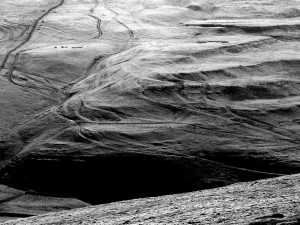
England is a very lived in landscape. It wears the past up front, it has been altered, adapted,  scarred, as needs and fashion dictated.  This isn’t the romantic wilderness but a  work place.WHERN K WELL

I have spoken before of  tenuous thoughts of how to combine the different strands of my work, the flat work and the historical costume, of how they should entwine,  and this may be the most successful  attempt so far.
I want this to be made of parts, remnants and fragments of things,  a landscape of layers and ghosts, of things half seen, half understood.
P1170577
It is worked over a found piece of crewel work, a chair back. The style has roots in the Jacobean designs, even the idea of a chair back or antimacassar is an old one ( They were to protect the furniture from the late Georgian’s hair oil!) Some will be unpicked leaving  holes to mark the pattern. Some will be exposed, some painted into the background.
On top of this are the usual lines and divisions of a landscape, but these are muted in colour and are worked across with text from an 1840 publication. And in this piece a dismembered garment is going to be embedded into the background and then the fabric plucked away in places to reveal the crewel work and the base fabric beneath.  Over the surface will be a landscape from Givendale in the Yorkshire Wolds.  My main job is going to be balancing these elements, not letting one dominate and trying to end up with a coherent whole...  I can try!  At present the work is about half way, garment is attached, most of the text done, plucking and fraying partly completed and a start made on the landscape. Does look most unpromising, but then a frockcoat half way through is like wrestling with a fabric octopus.


Wednesday, 20 July 2016

update

I' m feeling guilty for not doing more on the costume side - I spent most of the Spring working on the full sized costumes for the York Mystery Plays and apart from this have had very little time to do anything other than my textile-arty-stuff.  One day .......


If you would to see more of this  try franbramm.wordpress.com, on facebook or google my website.

Sunday, 2 March 2014

Princess line bustle dress 1

Spent months being quite tasteful, there just had to be a backlash coming. When I turn nasty I like to do it good and hard - luke warm just won't do. So....

stuck to the recurring theme of the neck to hem long lines and pleating into the seams, and even a bit of polonaising and went Victorian!  Instead of en ferreauing I have been princess lining, not  Watteau pleats but a bustle!  Nothing by halves. While nowhere as ornate or complex as this dress

 from the Met, it will be a fitted, bodice front opening  down to below the hips. From there the front  skirt will be fairly straight but the back will increase in volume over a bustle cage and finish in a small train. I hope.

New things to do, new mistakes to make, exciting. Risking taking and problem solving - okay, on a small scale but still fun.

Back to Janet Arnold and Nancy Bradbury for a start point, again they both looked at the same day dress from the Snowshill collection.   Brightest  boldest candy stripes-
there is lack of stripiness in the fabric stash but lurking in the bottom drawer is a nest of Hobbs pillowcases - still in their packaging - desperate to get out. ( Not mad, bought when sold off as old stock, nice dramatic patterns, tight woven cotton. Only survived this long because I'd forgotten them)  Totally inappropriate. GOOD.


The whole of this has been done on the model, no pattern pieces, just a lot of pins, muttering, tacking and then redoing. Pattern pieces might have been easier.  The back - six panels, each full length with the centre and side panels  having extra width  from about bum level downwards to make pleats for the bustle bit. There is extra length on the centre pieces as well, this excess gathers up  in the side seams to make the polonaise. Again I like the idea of the contrast - fitted sleek v volume drama.


The basic ideas worked very well, worryingly so. The skirt bustled quite effectively and even began to train. It could have been an inch or two longer but there are plenty of opportunities to trim and extend. Getting the false front in was a bit of a menace - maybe that should have been done first and the whole front assembled then put to the back. I ended up starting from the centre back seam and building the dress forward from there. As usual focussed on the fun bit - working out how the skirt bustle came together.  I haven't got this too tight at the waist - there should be an internal waist band to hold the bodice in place which will help. As this was done as an experiment there is no lining either which would have helped avoid the stretching and twisting in some parts of the back.
The front of the dress has a false front  with hook and eye fastening on the centre line. Fabric choice was interesting - there was some heavy black satin all lined up, or another pillowcase - same colours tighter designs- or plain green or.... and I chose this Indonesian cloth. It was late at night, but having tried it all the rest looked safe and predictable. Not a wise choice as it had to be interfaced before it would hold the opening. Sometimes I like it other times it is sink into deep despair but unless something drastic happens it will be staying.  The collar is of the same contrast fabric, as will be the cuffs. There should be pleated inserts along the hem  - giving weight and flare I suppose- they may end up green and blue.


The sleeves are more tailored and shaped than the previous ones - in 2 parts and cut with curving seams. The sleeve head seems very shallow.
I did try a mock up of these and we are back to Pingu wings, flapping in the breeze. These current ones are cut with a steeper curve  but are still a bit flappy. The 18thC ones had lead weights but I haven't seen any reference to similar tricks for this. 


This is still very much under construction - final fit, finishing and trimming to do, all the fiddly bits, but it is looking better than I expected. I have enjoyed using the mad fabric choices - it is unexpected and instead of sitting there primly  saying 'aren't I historical', something else is going on. I will  have to do some thing to the front edges - the transition jars- a length of black grosgrain ribbon came off the pillowcase when it was dismantled - could be very useful.
It is starting to remind me of Yinka Shonibare's fabulous work but without any claim to be discussing cross culture references etc.

I had hoped to be finished by today - excuses are rather thin - keep falling asleep but did take a day out to join in with the Woolly Bike project with Cassandra Kilbride.  We were doing a Viking inspired bike as part of the Yorkshire Festival celebration of  the Grand Depart of the Tour de France this summer.  Very silly - I crocheted curly waves and half a snake. Di stole the show with a longship saddle cover and beard for the handlebars. The final exhibition with all 10 creations will be worth seeing!

Sunday, 3 November 2013


Fisherwomen project – just about done


The purpose of the task was to try out working from existing garments, find out what information was needed, what was important, and how this could be translated into a Gwendoline costume.

Stephen's loan of the costume from the “Women's Voices” project was inspired.

Task 1 examine and record garments, drawing, measuring, noting details and guessing at construction methods. Learnt under duress  the need to be very methodical and precise.


Task 2 – look for contemporary images, artefacts, sources – comparing to and looking for contextual background. This was far more time consuming than expected. - internet is great but it still takes time – finding images on google wasn't enough – paintings had to be credited and checked against the photographic records. Both have drawbacks , the “naturalistic” poses, the romantic visions, the selective subjects, but both gave a lot of information about how such garments were worn, by whom and idea of when. It did feel a bit like cheating knowing that the costume was based on Sutcliffe's photographs and having some knowledge of the Staithes group of painters. But I have found new, interesting artists and learnt a lot more about the fishing industry and the communities dependant on it. At times the lack of detailed information on the web is frustrating- pinterest images which have lost their origins, undated paintings, uncredited photographs. A lot is available in blog posts but it is hard to judge the quality of information and whether it is sourced fact or opinion. Part of this task was creating my own images-illustrations really- trying to imagine how the garments I had could have been worn. I am a visual being, so seeing made the necessary connection between what I was touching and the research I was compiling and reading.

Task 3 – Reconstructing the garments.


This was supposed to be the fun bit. Referenced Janet Arnold's books and other records to compare with other contemporary garments and to check my own observations with her far more informed and experienced notes! I redid the measurements and took a whole lot more to create pattern pieces and fitted them to Gwendoline. Oh dear -Gwen is only human-ish so quite a bit of adjustment was required. Marking the seams on her and fitting to them saved my sanity a few times. Following the original as closely as possible Gwen's version was put together, darts, boning casing, flat lining and then seams. The reduction in scale has caused the usual additional problems- and yes, I did end up using some thin but fairly rigid plastic packaging for the boning – and no, still haven't put the roller blind up. Fastenings are becoming a real headache – reducing the scale of buttonholes was unexpectedly problematic– the length shrinks to match the button but the width can not reduce beyond a certain point or it just doesn't hold the fabric edge. This is obvious now, but had to be learnt the hard way. I ended up working them by hand to cover the chewed edges and they look far too clumsy( take glasses off and stand back – they look fine!). I guess doing small scale detail on a fabric that frays at full scale was always a poor idea. The other bright idea – inserting plastic boning of unknown parentage – wonderful until I had to press the jacket! The next not really seen problem was the centre front opening – I was concerned about the buttons being too big visually but the real issue was the amount of allowance needed for the holes. The overlap is giant scale against the rest – it would cover the first dart on the opposite front if I let it. So no resolution yet – still questioning whether to try it, to find a new source for mini buttons, or to cheat and surface mount the row of buttons and have hooks and eyes underneath.

Oh well.


Do you like the background? a bit Wuthering  - an old painting of N Yorks Moors but it seemed appropriate for a Whitby based project. And of course I like the back best.

The project is just about done – some tidying round required. Sorting the button issue is the most obvious thing but I would like to redo and improve some of the paintings – I have to decide exactly what I want from them – they suffer from a lack of clarity of purpose and expectation. When all is complete I will condense all of the Fisherwomen posts into a summary page and attach. It has been an interesting and enlightening process – the amount and level of detailed notes needed was an eye opener – working downstairs and having the costume upstairs became my fitness regime. There is a huge difference between information used for looking and recording and what is needed for making!

Sunday, 20 October 2013

fisherwomen project 2 - attack of the paintbrush.
Having said that this week was to be sewing - it ended up being painting, drawing, research and painting. Very simple questions have stalled progress and of course I got distracted by all and sundry.

Task one - put in more depth and shape into the skirt on the first painting. Done. Still think it looks 1940s in style but it does have an airy, summery, breezy quality. It was worth sitting shivering in the garden watching how the skirt moved in a wind! Also tried with the original illustration - bit better but still oops. Might cut the right hand figure completely.


Task two - making. Progress is made although not as much as I had hoped. the darts were sewn in bodice and lining, boning channels made, fronts attached  and then shoulder and back seams. The lining was then basted to the inside of the bodice to act as a flat lining.  Side seams were  done, collar and cuffs attached and sleeves put in. This worked incredibly well until I tried to fiddle, to narrow the centre back panel. Some unpicking is needed and more fiddling to correct the correction! Another adjustment is in my expectation. I have a tendency to make things like a second skin and quibble about any looseness. Not the way to go in reality,  yes a 'good' fit but there has to be ease as well. Quite a lot of ease is needed  for outer garments or nothing could be worn underneath and any movement would tear the seams.  This was a working garment worn over chemise, stays and petticoats so some ease has to be allowed. I still tend to put it on Gwendoline and tug it tighter.


Task three- The second illustration.  I wanted it to be more gritty, less generalised, and to show cap and shawl. What began to bug was were the cap and shawl worn at the same time in Yorkshire, and how to use the shawl. There does seem to be regional variations in garments and customs, the folded apron seems to be a Scottish trend and the cap more of a Yorkshire thing. The costume had two caps included so a guest appearance seemed necessary, but no apron. In the found images some have caps, some have shawls as headwear but many have bare heads, I've been trying to work out if it was seasonal wear, Sunday best, or whether there was a decline in their use across the period I've been looking at. A lack of specific location and date for many of the paintings was a problem with that one!


 Homer, Tynemouth 1891
 Still in search of a contemporary style - the obvious group The Staithes group but I have been looking at a variety of art from Portsoy in Banff, Scotland, Cullercoats, to Newlynn and even New England.  The most influential artists being Walter Langley, George Murray and Winslow Homer. Most of the images I worked from are on my fisherwoman pinterest board.  The styles are varied, impressionistic, highly coloured, to realism and delicate watercolour, so it was a case of pick and chose and experiment. Comparing the artists' impressions to the Sutcliffe photographs there were more similarities than differences - the poses are similar, the photography tends to be still and calm while the artists go for more dramatic weather and situations.
 Getting the details right was a pain, working out how to show the shawl folds and bulk, and then of course it had to be a plaid example! Lacking a mannequin with a head, it was back out into the garden to work with the costume set up on a body with an upside down  vase taped on place for the head. The neighbourhood cat fled. Haven't seen it since.
The setting of the photos is so specific so I have set it near the creek mouth in Staithes, very distinctive and with plenty of contrast, texture and scale to make it a challenge but didn't quite feel upto beaching a fleet of cobles (but have placed a few figures in the background, Having listened to the "Women's Voices" having an empty space seemed wrong, the women never stopped working in one way or another whether the boats were in or out)

I'm not happy with the result - the setting works well, the pose too wooden  rather than the worker-for-the-soviet-revolution stance of some of Winslow Homer's. The face works well in close up but not from a distance. The freedom of the background has become too tight on the figure, having tried out the various approaches to painting the face shawl I then go and mismatch them. Pah! Far too Catherine Cookson. Will try the main figure again and grump down the sunny background.. It's the angle of the head, or is it?


Distractions - 1- making for the library event in November.(giving up trying to follow written patterns for the time being)
                       2- making little hats etc for the Innocent Smoothie Big Knit fundraiser for Age UK. Followed a pattern and got it wrong - back to improvising.
                       3 - trying out a new stitch from a vintage shawl pattern from Whitby. Hmm.
                       4- Barbara's picture -
                       5. trying acupuncture.


refs - "Women's Voices" - www.fishinarts.co.uk
          www.ganseys.com
BBC and Wikipaintings
www.sutcliffe-gallery.co.uk
 www.tbrj.co.uk
Memories of the Yorkshire Fishing Industry - Ron Freethy.

Plans for next week - sort out little jacket, sort 2nd picture figure,  find neighbour's cat, try more challenges, send little hats, present things for sale, more acupuncture. How did I find time for a job?and I'm still pacing myself not to do too much at once! Might try to squeeze in some housework? Umm.....



Sunday, 13 October 2013


Fisher women of Yorkshire - a less gothic version of Whitby.


Stephen Friend has loaned  a costume to me, made for the "Women's Voices" project by York St John University. It was based on Frank Sutcliffe's photographs of the 'fisher folk' on the east coast around the 1890s. It is a jacket and skirt, worn over a bright red petticoat, with heavy boots and large shawl. It is  a practical outfit of drab striped fabric, rather like a soft cotton ticking. The jacket style is conservative, fitted with two darts each side and boned. It has centre front opening with 12 self covered buttons, high neck with a small simple folded stand collar and tapers to a v at the front and centre back hems. The shoulder seams are set a little back from the top of the shoulder and the back has curving seams from the armhole to the hem.  The sleeves are long, gathered onto  unstiffened, buttoned cuffs. The bodice is lined, except the sleeves, the boning inside  the lining under the lower buttons and darts, and mounted on top of the under arm seam and lower centre back line. These have a narrow cotton casing. The skirt is quite full, gathered onto a waistband with a flat centre front section. It is made in three parts, with a centre back seam, open at the top and closed with a mother of pearl button on the waistband, and a side seam under the bust dart.  There are several images showing woman wearing similar skirts, some with rows of pleating or deep frills around the hem, most with large aprons, often large shawls, and in various states of repair. The skirts seem to be relatively short, well clear of the ground showing the stout leather boots, a far cry from the delicate Regency styles I've been making recently (can't image these ladies being held up as aspirational fashionistas in a ladies' periodical). From the look of some in the photographs clothes were worn until worn out, remade and worn again.(take a look at the photo of Polly/Fanny (ref 24-29 in the Sutcliffe gallery) and see the repaired and tattered state of her under layers)


I'm using this as a practice exercise for working from an extant garment. A page of notes, diagrams and images was first, looking for seams, pattern shapes and construction details. These should have been done to scale but ... but at least I did pay attention to proportion and placement, spent longest on colour matching! I saw this as a 'getting to know you' phase. The seam lines and darts were transferred onto long suffering Gwendoline and then pattern pieces made to fit. Trying to find a suitable fabric was not a happy morning, could have made it in plenty of Halloween spiders or Christmas holly sprigs but a simple stripe? Ticking seems to be endangered species, so much is quilting or crafting cotton and I object to insanely cavorting teddy bears in waistcoats. I did find one that was suitable-ish, but it was a delightful lightweight wool herringbone at £36 per yard – oops.

I have used a compromise fabric from the stash – a blue cotton pinstripe, a roll end of shirting, not beautiful, a lighter weight and not as dense, but at least I'll be happy re-cutting pieces if/when I go wrong.

The pieces are cut and ready to assemble, and there it stopped – streaming head cold has claimed another victim. I tried to continue making but having put the dart seam allowance to the outside three times in a row- quite a feat in itself – I am giving up until the head clears and the eyeballs fit their sockets again.

I hate colds.

I really hate colds.


I have tried to paint from Sutcliffe's photographs inbetween sneezes but with little success. I like the concentration on the seated figure but the standing figure is one that I guess was used as inspiration for the costume, so I've altered some details to match the made skirt. A lot of the images show the women knitting, she is meant to be holding a skein of wool for the other to wind or work. Unfortunately in my version she seems to be having an out of body experience!  I haven't found a late Victorian portrait genre that I find inspirationally different from the earlier styles. That is this afternoon's job, BBCpaintings and Wikipaintings be warned, as long as I can stay awake.


Hopefully by next week the self pity will have passed, the cold will be vanquished. Doing 1890s clothing means that machine sewing is the way to go, so this garment should be quicker than the previous ones apart from the fact that I'm trying to match inside and out. The jacket should be in the process of finishing and the skirt blocked out ready to work by the time I post again.


Many happy sneezes of the day.....