Showing posts with label 1800s. Show all posts

Sunday, 20 April 2014

white pelisse


Of  lovely April days, invasion of cat,  white pelisse, and other many distractions. This is the blog as it was meant to be!


Last week-

The making of the white pelisse-

The sun has shone, the grass and weeds are happy. The bees buzz, there are butterflies, the garden is in its purple Spring phase.  I might have been distracted from costuming but I have been refining copies and interpretations of fashion plates to show the latest additions to Gwendoline's wardrobe as well as constructing 18th Century items for myself, so it has been busy.

I decided to use a clingfilm  base and made Gwendoline a masking tape shell. This was sectioned into pattern parts and then cut and flattened to create templates- and it worked! There is very little gaping, or bowing, or pinching – all without any fiddling, adjusting or cheating in any way. Umm, wow. Don't worry, it won't last.


This of course has lead to unwise decisions, there is no point having patterns that will only fit once, I wanted to find out how flexible this approach would  let me be – 1820s shapes- lower waist, broader shoulders, exaggerated sleeves and decoration. The fabric is curtain offcuts – trying to look like a heavy weave cotton or linen but I'm thinking that the closest this has come to nature was being sat on by an invading cat. ( I yelled, it went from snooze to panic in one move, did a complete circuit of the kitchen tops and windowsills at full pelt before escaping out the backdoor, fled through the hedge and off down the road.... leaving me with hairy fabric and chaos!)

 One idea arising from the gingham frock (last week) was using the smocking as a substitute/sculptural form of gathering, so set out to try a Juliet style sleeve with the repeated gathered bands down the arm. I also wanted to do more with pleating on the bodice. Even my favourite pelisse has gathers above and below the waistline. This fabric is quite stiff, it will bend and flex but goes clumpy and lumpy on curves and bulks up very quickly. The pleats in the back look good but have left the waist heavy, a wider waistband than originally planned might be needed or else the waistline is going to end up the thickest part of the whole garment!
last week's progress


Having faith in the pattern pieces makes such a difference – and saved so much time. No repeat fittings, unpicking and realigning. Getting from 'what shall I do now?' to having a believable bodice took less than an hour. The smocking took about the same. If I had a brain I would have done the smocking before making up and attaching the sleeve. But the sleeve was a bit of a guess, I knew I wanted more fullness at the back rather than the front, and that Pingu arms must be avoided. So I began with a basic gathered sleeve shape and made the curve at the top steeper and off centre . It did take some minor fiddling as the fabric protested about curves but it sits reasonably well, although many sins may be lost in the puffiness. And of course the piece I cut as a pattern is now firmly attached !.
 

This week-
Overall the pelisse has worked quite well- the good times did not last  The collar was a problem, it still tries to stick straight out rather than relaxing on the shoulder. Repeated washing did not help it, the fabric has a great deal of 'boing' - it tries to reset itself to flat each time. The radial  pin tucks have helped  a little and something to experiment with later on. Fears about the waist at the back were well founded, it is thick and seriously needs stiffening. Perhaps come at it from the end - put a bow on the  waistband cb so the bulk becomes deliberate ( see little blue example above).
  I do wish this stuff would make its mind up - it bends when I don't want it to and is too stiff when I want it to bend.

 As a relatively plain pelisse it is fine, the gathers in the sleeves give it more character and style. The gathering on the centre back  should perhaps only be attempted with finer cloth. Poor Gwen does not look terribly happy it. It does nothing for her figure - the extra bulk on the waist is not good , there is nothing voluptuous or even jelly-on-a-plate-ish about her to give definition, she ends up looking like a tree trunk. In the plates above, the waist is so narrow in comparison to the shoulder/ sleeve line, and  Gwen goes in just a little and out not a lot. I do wonder about making her a set of stays /padded bodice-  can't pull her in but might be able to push her out. ( I'm sure I thought this before sometime - a little set of transitions with bust enhancer?)

One moment - repeated washing?  Knowing how much I enjoy domestic chores  you will have realised this had to be an emergency. Well, first the 'sharps' needle I was using was very sharp and I hadn't noticed, second time was due to creating drawings in pastels. The washing has caused problems, now the lining is not happy at the armhole, causing the wrinkling seen above, a bit of unpick and pull  will hopefully sort it but this garment will remain untouched until the pastel phase ends.

Distractions-
1. Pastels- not a medium I usually use but... apart from the dust .....they are quite fun.


2. The fake book. - it started with a charming photo posted on facebook from the Australian Jane Austen Festival in Canberra.  In the general flow of very learned conversation we decided the photo looked like a book cover, couldn't resist it, and....  Last time I caught up it was either Mr D would emerge a la wet shirt, or she had  just shoved him in.  The drawing took  over a morning and then working out the editing  programme took about the same. (Gimp2 - a free download, complex but very good)


3. Gave up putting it off and set up a website- AARGH.
 
  Pastels were easy, Gimp is straightforward. If I had known how to do this it would have been simple! Used Google sites, free, supposed to be an easy site builder, self hosting, and well I'm googled for almost everything else. Looking back, once the mind shift was made, it was straightforward enough.  Over riding the templates was the most frustrating thing - typing in black, size 12 in default font to find it published in blue, boxed in a corner and.......
Hopefully all sorted, hopefully,.... Feeling very exposed at the present.  Be warned - will have to start experimenting with promoting it next....
 
 
And totally recommend
BBCs   "At Home With The Georgians: A Man's Place. 
So much more than important people and oh look at the houses. Well done to Amanda Vickery.


Sunday, 6 April 2014

Regency summer dress with smocking details.

This week's task
- not so much working on a basic shape but looking at how to modify and extend this to create detail. Instead of straight gathering  I decided to make the gather decorative and an integral part of the overall garment design. This is the start of Gwendoline's summer wardrobe. Rather Georgette Heyer, fresh, bright, innocent.
Met Museum Spencer
Pelisse, 1815-20
Smocking has a long history, it is a way of using pleating to alter shape,  of drawing areas in and allowing fullness in others without fancy cutting. It has become decorative, patterns sewn onto the pleats, or  creating patterns by how the pleats are formed. When looking for ideas I  went for the latter technique, the former is something I associate with either Farmer Giles or small children.


 The associations with the second technique are no more promising - silk fancy cushions -  but  it did look more like some of the details of some regency clothing. The technique is simple. Mark a grid on the fabric and sew points together to make pleats. Most things sound simple in such basic terms! It did require precision, neatness and patience, not my natural skill base.                                   .
 
To keep life simple - gingham! The smocking grid comes ready made with  this fabric. Gingham was around and used in the period but sometimes as a stripe rather than a check. 

"My mother told me that my childhood had passed away; I was now seventeen, and must for the future be dressed suitably to the class of lady into which I had passed. ...
Two or three gingham dresses of different colours very neatly made with frills, tucks, flounces etc. Two or three cambrick muslins in the same style with embroidery upon them, and one pale lilac silk, pattern a very small check, to be worn on very grand occasions......”. (1814)   
from ‘Memoirs of a Highland Lady’ by Elizabeth Grant of Rothiemurchus.
 
So to begin...
It was going to be a bib front dress with a trained skirt but the fabric just wouldn't drape, the skirt was clumsy and gaped, so it was converted into a basic open robe with diamond back, high waist, straight skirt gathered at the back and overlapping front. But I also needed to know how much extra to include for the smocking, so experiment time....
the pieces

The purple sample is an interlocking leaf kind of pattern, made of 3 double rows of diagonal gathers. It seemed quite straightforward. The little squares pattern  is formed by pulling in 4 corners to a centre, this seemed more complex, first impressions are definitely misleading.
Areas to smock - sleeves, centre back, possibly the top of the skirt gathers at the back.  The back  gathers are large and left  a real question about how to deal with the fullness in such a small  area. The cuff edges are held by bias binding and the fullness above is pleated into the top of the sleeve  seam. This worked so well that I got carried away. Must remember that good ideas should be handled with care. The gingham is not really that nice, it looked so flat that a bit of detail on the skirt seemed the way to go. Could the technique be used to create interest and texture rather than gathering? Probably, but not by me! It began with the same pattern as on the sleeve but in miniature down the skirt front edges. This is a simple pattern but all of a sudden I couldn't understand it, which way should the diagonals go? How do they line up with each other? It also gathered up quite alarmingly, but looked great when rolled to make the edge. Phase 2 was the little squares,  2 side by side with a space above and below to make a column. So easy! This has  pulled up the hem but this could be pressed out  to a great extent. 
The dress was done, only the usual problems about buttons, I tried some covered discs but the fabric frayed too much at this scale so emergency beads are in place until I find something.  So of course I made an underdress out of the scraps, as you do.  The things I find to do when there is housework waiting and the lawn to mow..... I had intended a white slip, but the gingham fabric needed using up....


The positive - the sleeves. They have a sense of self importance and are more than prepared to stand up for themselves. It was surprisingly easy to work and they went in first time. I would imagine they would not be easy to wear, acting like shoulder pads, rising up to attack whenever the arm is raised too high. The gathering does work well visually, but caution is needed. For some areas a separate panel  might be answer. If I had sectioned the back into 3 it might have sat flat. against the torso. 
Negative - distortion. The front will need to be blocked to flatten it out a bit more. This will happen after the wash it needs and re buttoning. The self covered button idea looked charming  but was impossible, they needed recovering every time they were used. I must find  a decent solution to this as the beads are too small, the dress looks cross-eyed.
 
Would I make this full scale? Yes, but with modifications, and not in yellow gingham!
 
 And then the fun bit - creating a fashion plate-  The pose is from an 1824 Ackermann's Repository ball dress. The lady was eating an ice but  this has changed into sewing.
oh, and of course....
The Hider of Scissors. My own personal sewing demon, mischievous not really evil. 


Sunday, 30 March 2014

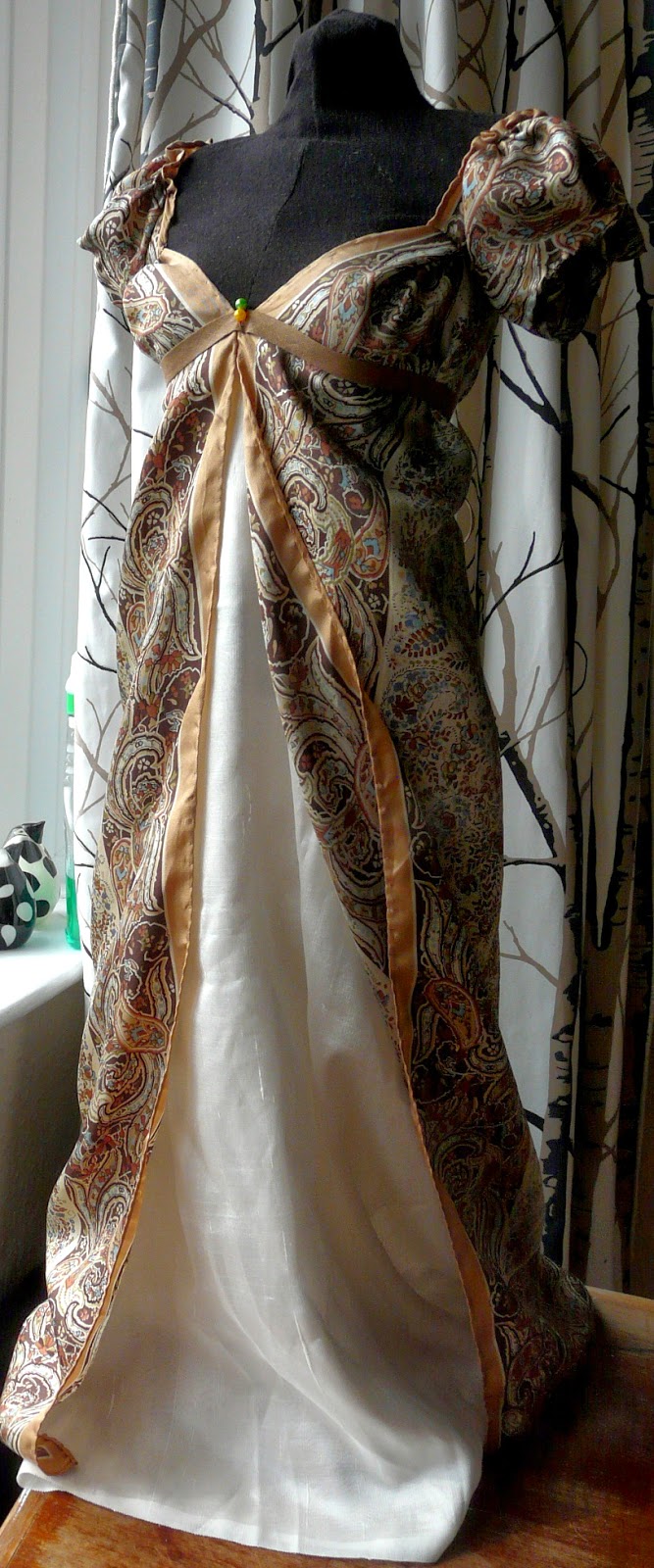
Regency shawl dress, Gwen shall go to the ball!

I claim no responsibility for this. A query was posted about using saris   to make a regency style ball gowns, they are a good source of fabric, richly decorated  and often excellent value. The responses cited the trend for dresses made out of the imported Kashmiri shawls in the early 1800s, something I'd known about but not really considered.
I just happened to be in a charity shop getting my breath back having cycled into town, it just happened to start raining so was reluctant to leave, there just happened to be a silk scarf of a sort of  Indian design, sort of the right size, so I bought it, and this happened......

Context first -  there are many pictorial and extant examples around, the shawls were huge so offered many options from the drapey Greek style chiton approach to using as a standard dress length of fabric.  The fabrics varied as well, from fine cotton and silks to heavier winter weight wool. The first blue dress was the one that began this little episode, from the Snowshill Wade collection dated 1815 and documented by Nancy Bradbury in "Costume in Detail". The second image is merely to show the volume of fabric and the ornate border of a shawl, the third is an 1810 dress from  Museo del Traje and  the blue print ensemble is  Empress Josephine's ( not entirely sure if this was made from shawl lengths or  fabric printed to look like it, one site is sure, another is not! but it has the same feel of using the imported pattern). They all make use of the borders and trims  especially around the hem and neck. The fashion plates show much the same  story but with more accessories, more ornament, layers of detail and pattern.
 
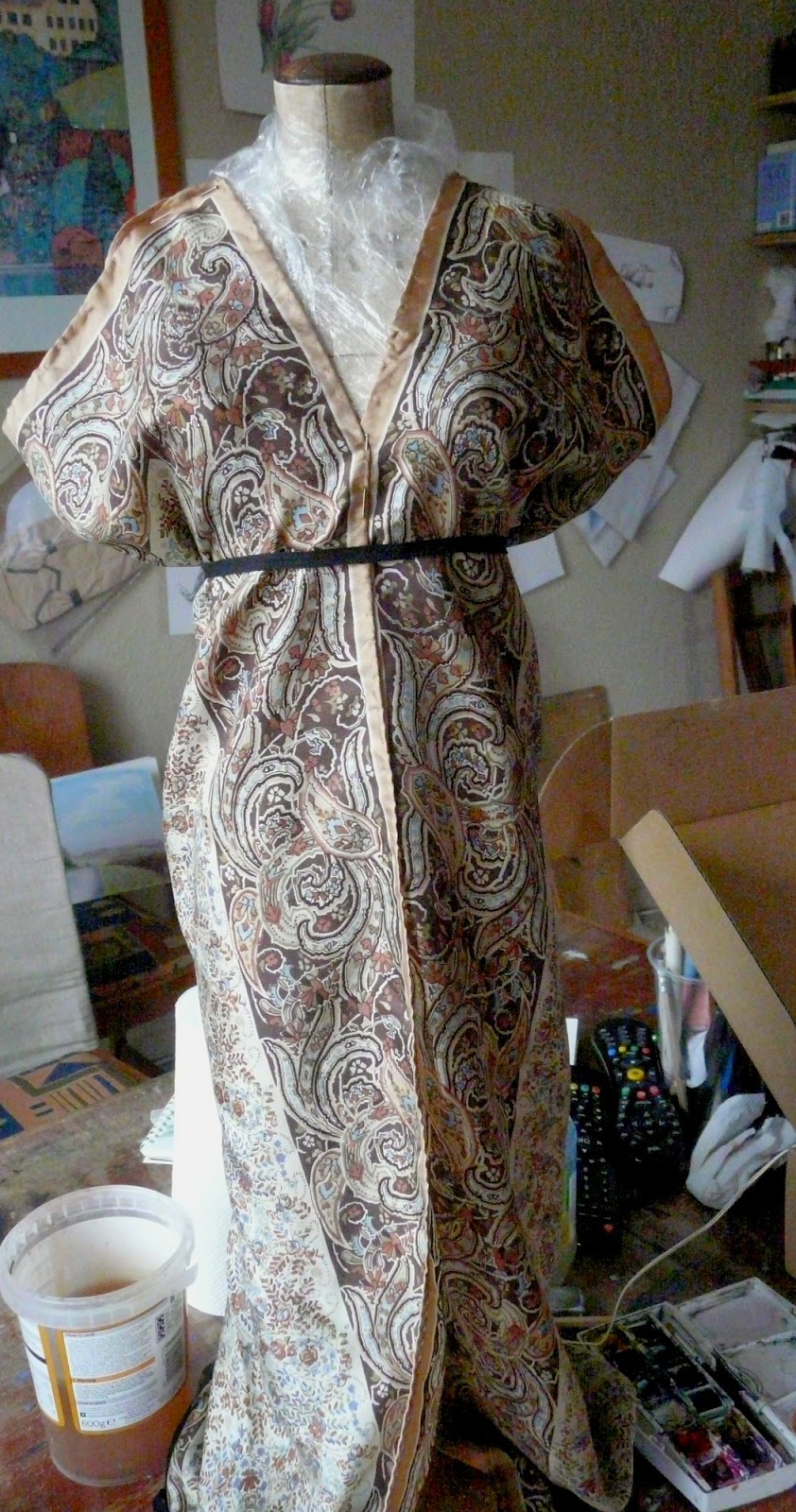
The original shawls were long rectangles with ornate ends but mine was a 30" silk-ish square with a printed border all the way round. A garment for me? No, remarkably draughty. A garment for the faithful Gwen. To the right the scarf is  folded into the centre and pinned at the shoulder to give a very basic drape. The challenge will be to stop it looking like a dressing gown. I like using the border  in the centre of an open dress but Gwen needs much more help and structure to give her shoulders, somewhere between the profiles of the  green and first red fashion plates.
 The dress is fairly simple, the only cutting was to take off the top border, This reduced the length and gave something to make the sleeves out of!
 
There are 2 rows of gathering to create the bodice, on the high waist line all the way round from border to border and at the centre back along the top edge. The front is joined at a point 3" down and the very top of the front border is pleated back onto itself to give the separation at the bodice.   Each sleeve is half of  the sacrificial top border, sewn into a tube for an inch and opened flat along the top of the dress and  attached. They are gathered at shoulder and cuff trying to give that extra breadth  across the top line. I did reserve some of the yellowy border to do the front trim but it has escaped at the moment, so a length of elderly bias binding is playing understudy for the photos. It gives better definition to the bust but is rather clumsy  tied at the back. If I can't find the renegade trim this is all I have left of the fabric to work with - wish me luck!
 
And the most important question of all - Does this make Gwen look less like Juno, athletic and wholesome, and more of a siren, has she achieved cleavage? 

Certainly like the wider shoulder, even if they had to have stuffing shoved (romantically) up the cover to stop the sleeve slipping off. The back is a bit too much, may be lose some gathering to the sides. For such a straight forward idea this has not ben easy. Getting one side to work was simple, getting the other to match was a pain. The fabric was lovely, to look at, but had no substance. It lost all shape and form unless it was on the model so that was how most of the sewing was done. If I was making this for real the seams would be taped and the bodice mounted onto a lining.  I must take a pattern from this and try with a more meaty fabric, with some adjustment this could become another Gwen wardrobe staple. At least it is her very first grown up ball gown. Not bad for £2.49  ( cheap date).

Some useful sites-  There are loads out there, but will there ever be enough time to read them all?
http://historicalclothinganduniforms.blogspot.co.uk/2012/03/not-only-shawlshawl-dresses-and-dresses.html
http://thedreamstress.com/2013/01/the-kashmiri-shawl-and-the-dress-made-of-kashmir-shawls/

http://www.fashion-era.com/regency_fashion.htm
http://www.marquise.de/en/index.html

Sunday, 16 March 2014

Pelisse- recycling and speed challenge

Spot of light relief this week. I'm putting the time into completing large scale pieces so set a quick challenge.
Task: buy a charity shop garment and create a  regency garment for Gwen in a day. Complete it for under £5, all in.

First find the garment. I was expecting soft cotton summery frocks, flowing skirts, delicate prints. Nope. Still in deepest darkest Winter mode, scratchy wool, jersey knits, heavy colours. There were some nice pieces but not enough fabric  for the price. Ended up with a fake denim look skirt for £2.99.
Issue one - denim? Time correct or not? Serge de Nimes was certainly around  but used for work clothes. Issue 2 - this is fake denim - it's tencel and the distressed and faded bits are manufactured. However there was quite a lot of it, it is quite soft and flexible. I will lie through my teeth and call it 'cotton twill'.


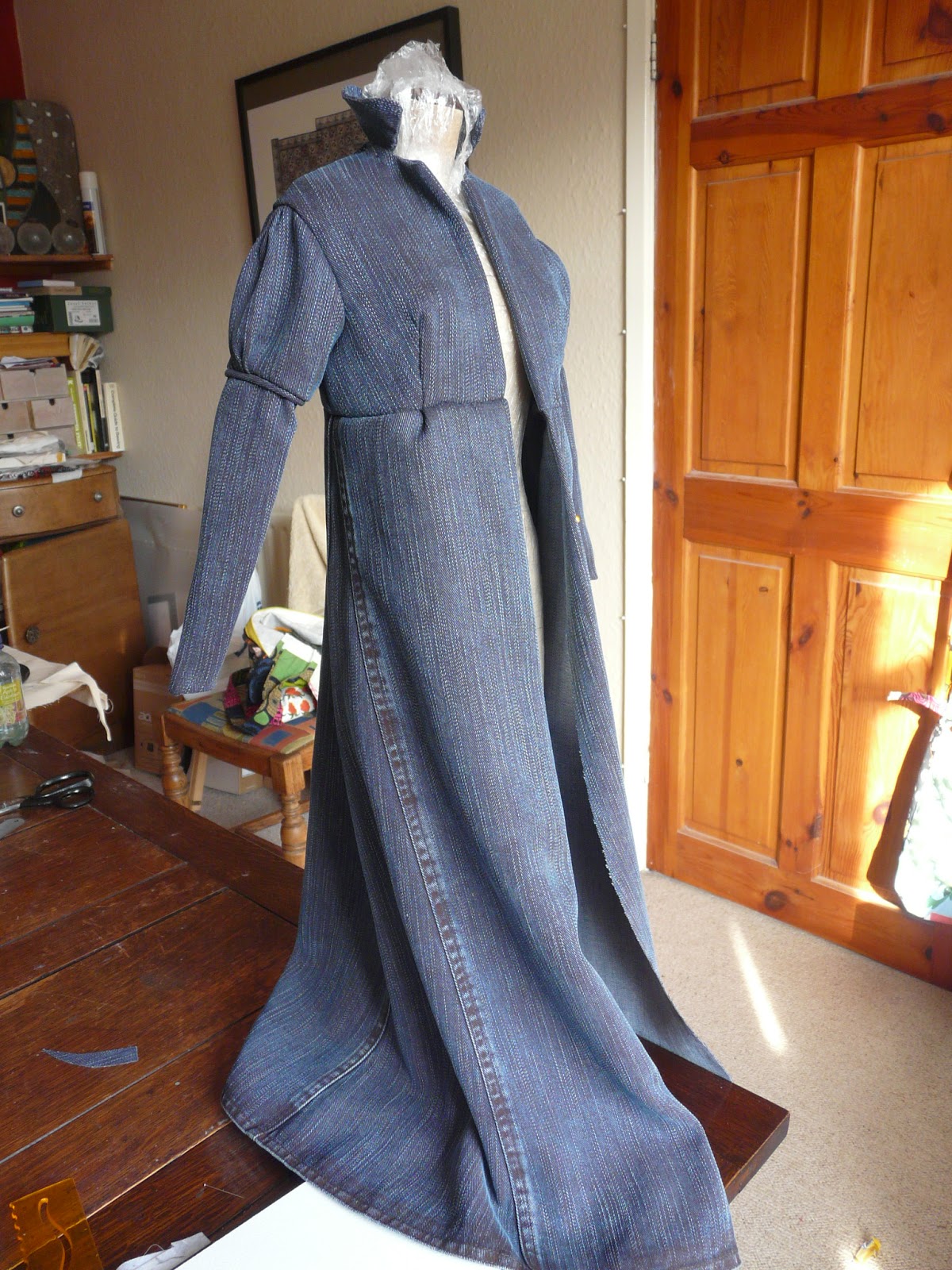
Second - decide on the garment - a pelisse, long ladies coat- think spencer with a skirt. Still like shapes  they make. It is also a flexible thing, the complexity, cut and fullness can be altered to suit the available fabric. The basic shape was meant to be like these examples, high stand collar, short revers and falling quite straight.

Third - sort out a pattern, fitting a quick draft for the bodice to see how much  fabric would be left for the skirt.  The pieces are quite standard but the number of large pieces is a problem, fitting them onto  the largest area of material  means a reduction in the skirt width.
It is unlined (couldn't find a lined skirt I wanted to make from!) so the front is extended to make facings which are turned inside  to make the revers. The sleeves were the most complex part- it had to be in 2 parts to fit on the fabric-, the top is cut wider and  pleated on the centre line, the bottom is tapering to the wrist. I'm not using a pattern for these- it will be maximising what is there after cutting the front  and centre back out. The side pieces and collar are small enough to fit on the scraps.


Assembling - fairly straight forward - the most time consuming area was the sleeves, fixing the pleats and finishing with piping along the joining seam took about 2 hours!. The seams are top stitched to flatten them but otherwise un finished to get the whole thing completed in the  time limit.    Sewing through layers of this fabric was difficult and then painful so short cuts for the skirt were most welcome.


The photos are a gallop through the  process, making the bodice, working the collar, making and attaching the sleeves and then adding the skirt. The skirt is nearly as found - about a 1/3 of the original garment was used to make the bodice so not much room for manoeuvre.  There were 2 triangular inserts  which I  placed on the  side seams to flare over the hips Gwen should have,  and then gathered the excess fabric at the centre back. It is really too long for Gwen, but  in keeping with the "up-cycling" theme it seemed silly to cut off one hem just to make another an inch away! I tried working out the proportions from the fashion plate  and this isn't too far away.

The front is just slightly crossed over and is held with a loop over the bottom right of the 4 buttons. The collar stands without any problem and would frame the face nicely. The frothy lace is just some scrap placed in for the photo, but it does seem to finish the look, the power of accessorising.


Summary -  I don't know what is happening with the photos - the originals are great but the upload seems to be having a bit of a migraine attack with them.
One simple pelisse done in the time allowed using all but scraps of the original garment. It looks like a warm, winter weight garment, quite plain and functional rather than grand and fancy. The only purchase was the victim skirt, all threads and buttons are from the leftovers of other projects. The problem areas are the bulk on the underarm seam affecting the hang even with the seam allowances clipped, and I set the collar about 5mm too far back.  The last is annoying as I fitted the collar and then shortened it !
 It is crying out for more embellishment. The buttons have given a focus to the front but there is plenty of space for frogging or decoration - and on  the back . I did toy with putting a belt across the centre back piece but I like seeing the tops of the gathers, that contrast between the smooth and then the volume is a beautiful detail.  I do wish that I had deconstructed the run and fell seams on the skirt - the machined lines and artificial colouring is distracting. If I decide to make more of this coat then a bit of unpicking will have to happen.

At the moment I am suffering from sewing finger -
the needle used was a 'sharp', slim and very pointy, unfortunately it was sharp at both ends, one finger has lots of little perforations from the point and the other is sore and shredded from pushing the needle though! Solution - toughen up the skin - no more washing up and cleaning windows, perhaps even weeding will have to go- all that washing of hands......

Sunday, 26 January 2014


So - it was going to be a painting week, that is happening, but while the watercolours were drying I got distracted again so had another go. This is glue-and-fabric-dress mkII. Do need a better title for them. This time it is based on the late 1700s high-waisted open robe shown in Nancy Bradbury's Costume in Detail. The extant example, from the V&A, gives an idea of the style of dress, The bodice detail is different but the general shapes are similar.  The Bradbury one is cut low ( very low!) and pinned edge to edge at the centre front, while the skirt has double inverted pleats and gathers to give the fullness at the back but remains open at the front to show the petticoat.

The start point was the same as for the ghostly dress - a papier mache cast of a little body form perched on a stand. I  took a pair of scissors to it and had narrowed the hips out of existence, there is a much cleaner line from shoulder to hem as a result.  Frustratingly the first steps were regluing and then creating a simple petticoat- just a rectangle of muslin gathered just under the bust. The skirt was cut and pleats pinned in using the Bradbury measurements to approximate to the proportions (bodice=1 unit skirt length =5ish). Back to the dunk, drape and dry routine, thank goodness for elastic bands to hold it together as it sets! And yes my high tech set up is an upside down bowl for it to stand on, and a plastic biscuit tin to catch the drips.
This was where I  parted company with dress making procedure. Instead of making bodice and skirt separately and then mounting together, the bodice was built panel by panel up from the waist.  The edges are still being turned under like seam allowances which did lead to problems, but working like this made fitting the sleeve on much easier. I could smear the glue, slide the sleeve head around without destroying too much this time. Should have put the cuffs on before assembling but.....

This was close  to the finish - the sleeves are on - looking a bit like Victorian insect specimens with the pins everywhere. All that is left are the shoulder pieces- they go from just above the bust over the shoulder and complete that distinctive diamond shape to the back. And then re gluing the inside to strengthen it. And adding another muslin petticoat inside the first - it was indecent (and a bit short) . And re gluing the skirt hem and turnings. and not dropping it. and not sitting on it (genuine accident not vengeful malice, yet)
And (last one), of course the belt! I did try the tie at the front (dressing gown), did try with just the organza ribbon ( no clarity, looked slightly dirty against the white), the pink ribbon (too narrow). So we have the double layer of organza and satin.
 Be grateful - having watched the BBC's Rococo programme this week with Clara the Rhino, I did try a tiny elephant as a brooch on the front. The tiny pink bead  is sweet but does make me think of a nose. Ummm. 
The muslin at the neck is temporary, preserving modesty again - these high/low dresses must have been seriously draughty. It looks 'right' and certainly stops the unfortunate Headless Horseman associations. I think I will declare it permanent! Hurrah!


  As you can see the technique is still evolving. Working out unwanted creases and dents would be a useful skill, as would  compressing seams and joins without leaving holes  or clip marks.  I do want to get artier with it as a process - more Wuthering Heights than Jane Austen as a expressive medium..... but she does look quite good striding purposefully across the window sill.

On a different note - so much for organising my working area. She is upstairs in the bay window  making the most of the natural light for photographing her, I'm working in the back room watching Sherlock Holmes wrinkling his brow in deep thought while doing this. At my feet are my painting things ( painted an inch of the nice sofa as a protest against the vile weather) and the experimental hand sewing swag bag and contents are on the squidgy chair opposite. The Front Room is the work space.   I begin to think that where ever I want to be becomes a designated work place.  Well, the house was never meant to be tidy, was it?
Never underestimate the power of blogging! There is blue sky! If stays good over lunch then I might make it out to see round the windmill!