Showing posts with label 1700s. Show all posts

Sunday, 19 October 2014

Fairfax project 1750s

New week, new task. Travelling back in time ( wibble wobble, wibble wobble) to 1750 or there abouts.  Location Fairfax House o Castlegate, York.  Minor difficulty is that the house was built 5 years into the future, but the portrait I'm taking inspiration from did exist, and hung and currently hangs there.

Hope that is clear.


in situ in her bedroom
The portrait is of Anne Fairfax is dated 1750, showing her as a young lady shepherdess. ( quite a common conceit  - see It's About Time for more imagery.)  Lady Anne was the only surviving daughter of Charles, 9th Viscount Fairfax of Emley  and the house was built for her. The painting  hangs in her bedroom facing the bed and she apparently was very fond of it.
The painter, a French artist who worked extensively in England, is Phillip Mercier. He lived in York for a time, painting many of the society ladies.  
 The painting is very whimsical, but I think I quite like it because it raises questions,   the rose at her breast is rather odd - painted differently, and there is a mystery orange line across her chest, plus one of the sheep looks like a neighbour, but it will do as the start point for a costume task.  I would like to recreate this - or something based on it. ( If it goes well in diddy scale  it might get made full size!) 


quick initial sketches and notes

The painting does pose some problems - it was about her and the allegory, not her dress. The two sleeves are different - one fits smoothly at the shoulder but the other is gathered into pleats, there is a faint line down the centre forn suggesting  a seam or an opening, but the brush work at the junction of bodice and skirt is so loose it is going to be interpretation and best guess. My assumption is that the dress is conventional, a closed bodice over a full skirt. The closest example I have found so far is the 1780 wedding dress from the V&A exhibition to the left. The low scooped neck, tight bodice and pleated skirt are what I am imaging. Just 30 years difference.

But the current question is really about the fabric. It shines so must be satin or silk, but it looks much softer in the creases and on the surface than the pink drapery, so it can't be the same as that. Could it be fine velvet?  I took some samples of satins and silks in to compare with the painting and remained unconvinced by any of them.

While all of this is happening I have not been idle - much.  I am now in possession of a 12 inch artist's mannequin and am trying to make the underwear to fit. It is currently nameless.

Progress  so far has been good, 'she' has  a chemise - with gussets!, an approximation of stays, and even pocket panniers.

The chemise is to an C18th pattern, the standard issue, rectangles and underarm gussets (- much the same as the blue print used for gentleman's shirts)
very masculine....


The stays were more of a challenge - boning, binding and eyelets! The boning I will admit to being narrow cableties, The binding is the smallest I could make, and the eyelets - I know they should have been hand done but.... so they are just what I had and are completely huge!  The first try was agonising but these ( version 2) went together quite simply.
The stays are really so that I could alter the shape of the torso - widening at the top and narrowing at the waist to the C18th cone shape. This is partially sucessful so more padding may be needed. Added padding to the upper back as well as bust  and it has made such a difference- happier now. 
They could do with more tabs at the waist but that will have to happen on the next ones.  

To give the exaggerated hips I decided on pocket hoops/panniers - small cages either side rather than the full width one more associated with formal or court dress. The discussion was whether to go for bum pads but actually wanted to try out the panniers! Umm.

They were based on a pair on display in the 'Head to Toe, Accessorising the Georgians' exhibition currently on at Fairfax House. Although fiddly at this scale they were fairly straightforward- channels were made in the outer panel, one side of the inner panel was attached, the bones slotted in and the other side seam made.

That the inner panel is narrower than the outer gives the tension to create the required curve. The top is pleated  to fit to the waist and sewn onto a band. Simple!

The overall silhouette is an improvement- would still like to pull the waist in more - the contrast between waist and hip should increase anyway as the petticoats are added so this is not crisis thinking yet.

Wonder if I would warm to her if she had hair?
Definitely lacks personality at present. Any suggestions for a name?

You never know - might have tidied up by next week.


Sunday, 8 June 2014

chemise a la Reine - Gwen style.


This week's effort was meant to be light relief – I think you can guess what happened.
I picked an iconic garment from the 1780s; the chemise a la Reine. You probably know the dress even if the name is unfamiliar – think English country house portraits with white fluffy dresses, frothy at the neck with big coloured sashes and ribbons. The setting may be countryside, the lighting dramatic. Big picture hats, and occasional dogs or children.

This had begun life as a  'gaulle'  (robe a la gaule), a loosely fitted  dress of layers of muslin usually worn with fichu and apron. It was picked up as an informal relaxed style by Marie Antoinette and popularised by her, she even sent examples to the Duchess of Devonshire and Mary Robinson in England. It became known as a chemise a la Reine,  an insult - the Queen's underwear. This did not stop the dress becoming popular wear at  Petit Trianon and amongst the fashionable classes. The queen was criticised for  this - it was not suitable or appropriate for one of her status. Even the fabric was seen as unpatriotic,  the expensive cotton muslin had to be imported at a time when the home grown silk industry was in decline.

The basic idea of the dress is very simple- think sundress with sleeves. It is a large tube gathered at waist, neck and sometimes inbetween, to fit.  It has shoulder straps  and sleeves which are gathered at various places. Some have flouncy necklines, some lace, while others are left plain. Lots of ribbons and large sash complete the look. For 'simple' garments some examples are extravagant and flamboyant  expressions of wealth

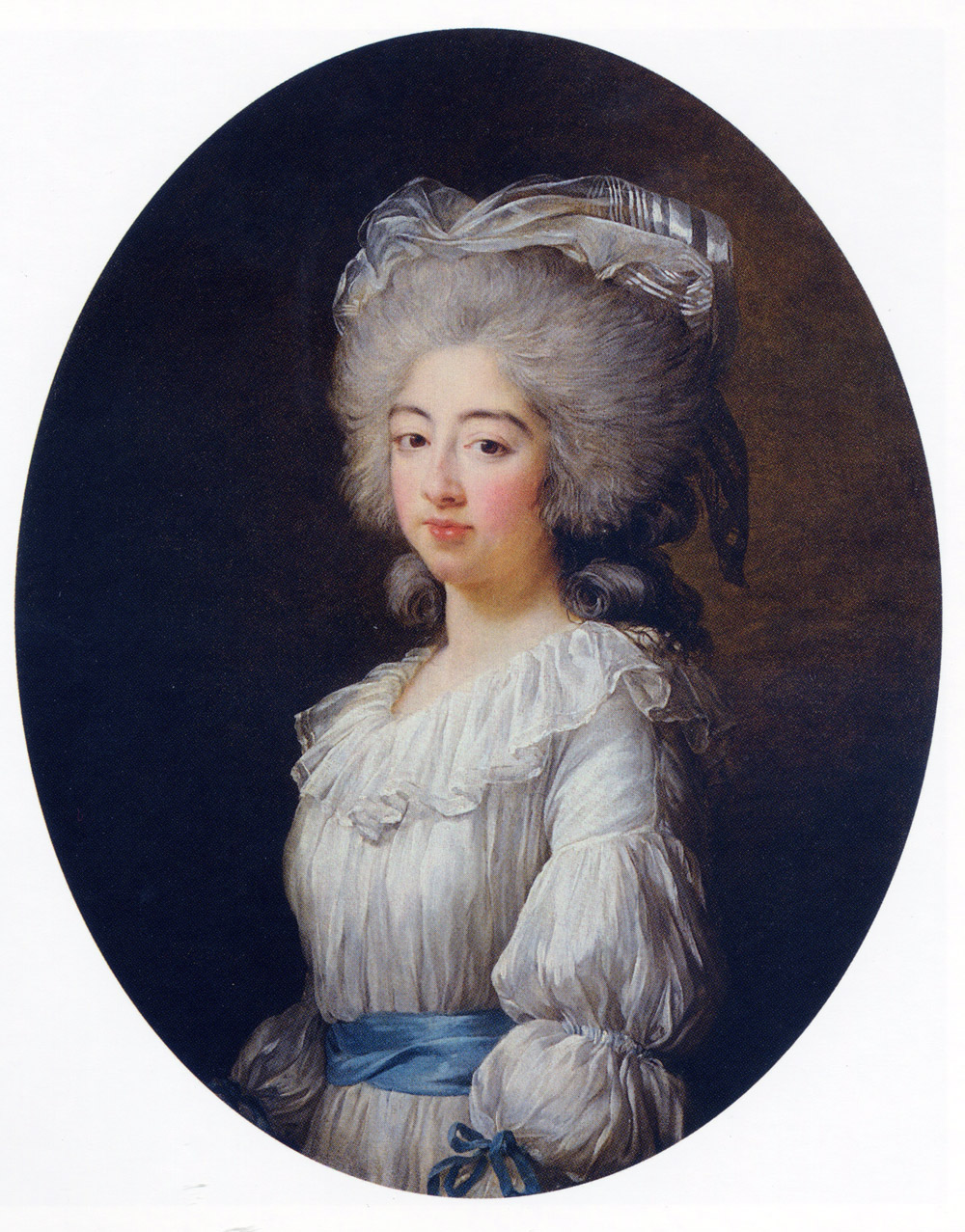
There were many examples to select from,  Vigee LeBrun painted many of the grand ladies in the dress, remember the infamous one of  Marie Antoinette?, but this is the one  that appealed the most. –   a rather detached looking French lady and I liked the sleeve details. 

This portrait is of  the Countess of Provence, Maria Giuseppina of Savoy (known as Marie Joséphine in France)  dated 1782. ( Wikipedia is not flattering but in outline - she married  Louis Stanislas- younger brother to Louis XVI. They  escaped the violence in France and established a court in exile,  and following the death of the Dauphin her husband was declared King Louis the XVIII, she died in Buckinghamshire in 1810!).

There are many blog sites describing the making of the chemise but the only pattern guide I have found is a diagram from Norah Waugh. Unable to print it out, I measured off the screen, (umm) and drew up a rough outline of the main parts with 'hopeful' if not aspirational measurements.
 Norah Waugh's has 3 rows of gathering, the top neck edge and the 2 channels marked, Marie Josephine  only has 2 rows on the body, the top of the sleeve has a tighter band (can not make out how this is done), and a lace collar. Could not see the bottom of the sleeves so  prepared to make this up - as if the rest was incredibly accurate!

This an approximation of Waugh's outlines - I was able to cut the whole body out a single piece so the only seam is centre front. The circumference  of the tube is 1.26m to fit a bust size of 43cm! The sleeve looks huge -  45cm wide and the top of the sleeve is flat, the cuff is curved, which feels odd. So far it looks easy, and quick. Time to get real - fell seams ( I did French) = 2 rows of stitching, rolled hems on every raw edge, each gather needs a casing = 2 rows of stitching, and it all adds up.

The muslin I had is a gentle yellow tone rather than white, quite nice quality, evenly woven without slubs or snags. Meant it looked nice as it unravelled.

Making up -
The back neck edge is gathered onto a fixed band of cotton
tape to give some stability. The front neck edge is folded to give the dip to the centre front and used as a channel for the first drawstrings- these run from the armhole forward, I made eyelets so that the ribbon 'strings' could come out to the front to be tied. The waist channel (5 mm cotton tape) was marked and  stitched to the inside and the front seam closed upto Gwen's waist level. The remainder of the front opening was hemmed and folded under.

This was the body of the dress done.  Next was the shoulder pieces, These were adapted to fit Gwen but the rounded 'serifs' top and bottom were kept - these gave a rounded transition from shoulder to front and back neck.


 In the first image the sleeve is pinned in situ to get an idea of the space the strap has to fill, In the second the strap is drawn onto fabric and problem one is found - should the front be gathered right to the armhole or just to the edge of the shoulder piece? Opted for the second in the interests of reducing bulk. The bottom photo shows the sleeve coming up from below and attached to the strap lining piece. to the right is the front - seam done and the allowance folded upwards. The top part of the strap is already attached ( along blue line) and waiting to be flipped over to be edge stitched down onto  the same seam line as the lining. This encloses all the nasty raw edges. Sounds like a headache? Not really, just takes some planning, fiddling and patience. The result works well, no raw edges inside or out to worry about.
  Have you noticed problem 2? Forgot to reduce the top of the sleeve. Lesson - big, BIG stitches preferably in neon colours if ever you want to unpick on muslin. Having done some damage attempting to unpick the sleeve  an executive decision was made - live with it, reduce the top sleeve width by other methods.
Sulking gently it was neck line time - and no lace to suit! The modern stuff was toothpaste white or just not long enough so.....
Introducing extant example from Manchester -take a look at this site for fantastic firsthand details and images, This had a flouncy double frill at the neck,  so cut on a curve rather than a straight  gathered strip. This gobbles up huge amounts of fabric and is a pig and a half to hem. Nevermind. Bit of grit and a packet of biscuits ( plain and not greasy) and it was done. Done and then some - it is too much. And it is a nightdress. Hum. Not quite so bad with the waist drawn in but still..... problem 3.

Solution time.
Problem one sorted en route - only gathered the front neck edge on strings.
Problem 2 - needing to draw in the fullness at the top of the sleeve - smocking to the rescue. Did 2 rows of simple square smocking at the top of the arm ( mark a square and pull the opposite corners into the centre and secure. You get a four petalled flower on the stitch side and a square puff on the other. Just repeat.)  Probably should have done 3 or 4 rows for a denser effect but they can be added at will.

Problem 3 - uber frilliness. The fault lay in fully opening the neck gather and stitching the frill along its length - 25cm worth.  Solution was logical, less gathering . So unpicked the front,then gathered half of the neck edge and secured it.  Re attached the frill taking  11cm  off its length each side, neaten, and rejoice. The reduction in the amount of fabric in the frill  has helped a lot.

All it needs is sleeve gathering channels - surface mounted  muslin strips this time. I did experiment with more gathering rows but it became too congested - There is also the option of adding lace frills if it feels unfinished.
Washing time to get rid of the blue marker and then photoshoot!   Done. (not done - see the following posts!)
Odd thoughts - in the photos it looks Edwardian.But so did the Manchester one. I think the proportions may be out - more hip and less bust required?  The frill is too wide  -compare to the portrait- volunteering to re-hem all of that on the bias? - next lifetime may be. Meantime out with the bum rolls. Could possibly just roll the hem again? NO.
 Time for tea.
 But maybe the length of lace I just found could do the neck line better........ These are just details  the dress itself has worked well. There maybe an occasion to try the third row of gathering on the bust line in the future -  but it is huge - the volume is immense - 3 or 4 lengths of fabric for full size! No wonder they were considered as frivolous expensive things.....

Stray thought -Just trawling through images with no idea of the stories and history behind the people shown, so do tend to see them just as pictures – more likely to assess painting style and dress than anything else. By finding out more about the sitters, these are now dresses worn by people- not sterile museum exhibits. I started feeling uncomfortable about seeing them entirely as artefacts particularly as so many came to violent ends- what they wore only a few years before became less important. It is a little relief that this lady survived the Terror- imagine if I'd picked the next portrait along - Princesse de Lamballe - Marie Josephine's sister.

Sunday, 1 June 2014

LACMA 1790 tailcoat - disaster


A productive and busy week. Completed a commissioned drawing which was pretty concentrated work, made an appalling fabric choice and set out to try the Los Angeles Museum of Art's (LACMA) pattern for a French 1790 tailcoat. This I thought would be a counterpoint to the ladies jacket completed a couple of weeks ago and a way of consolidating some of those new techniques. Oops. In fact, OOPS.

    Click on the picture for the LACMA collections page or on the link for the patterns page. Of course this  is the last one listed-
 
The LACMA download includes gridded outlines to scale up, very brief notes, and one drawing of the centre back detail. It looked enough – having worked from Janet Arnold Fashion and from the NSCT pattern sheets- this was familiar territory and usually what I don't know someone else will tell me about. The usual sites offered general information  - http://www.marquise.de/ has a useful over view and some tips but the example she makes is from earlier in the century.   It was still useful to get me started - the general garment did not seem to alter much over time, just the styling and details. My general research led me in to allsorts of odd corners, how to get curled not flat revers, how to do the rolled collar, welted pockets,  more Garsault- L'Art du Tailleur (1769), but I have survived.
 
 
a close match?- David. Louvre


The fabric was lovely, at least to look at, a purpley maroon with a top layer of fine soft gold and a woven pattern of trailing flowers. What I didn't appreciate was the low ironing temperature, its indestructible belief that creases are bad and the world should not have corners, and as for its ability to fray, to split at seams, to distort – utterly world class. The lining was the vile berry stuff used for the pink and dotty pelisse, so at least it was a known pain to deal with. Enough moan.


I think the pictures tell the story of its construction quite well - step one was making the pocket - and yes it is a proper opening one! From then on it was flat lined through out the major construction, back first then side and shoulder seams. Padding, interlining etc were tried one mad afternoon on the fronts but discarded - they were impossible to manage at this scale and attempted to bully me - never goes down well. At this point all was rosy. It seems so long ago....

It was collar time. The lapels form part of the front; there is a seam down each side roughly under the buttons and the points are curved back to make the lapel. This where it all goes wrong - the angles are not right, the roll back is too large and in getting that seam to sit in the right place the fit of the back is lost. This became apparent later; it was initially disguised by the Battle of Pad Stitch. This was pointed out as the traditional way of getting layers of fabric to fold or bend - as in a shawl collar or rolled lapel. Good little me tested it  and then applied. On one side the pad stitch is through an interlining and the underneath fashion fabric - not ideal but it seemed to work until the fabric started to separate and break up. On the other there is a pad stitched interlining sandwiched between the fashion fabric. This was fine with the bottom layer but was not strong enough to resist the top layer's desire to bounce back. The back of the collar was done in one rather than 2 pieces, for reasons of sanity, and pad stitched to death or at least until it stopped arguing.  It is not pretty from the inside but the stitching is hidden by the collar fall from the outside.
Sleeves were added - standard 2 parters, but at least I remembered to add the cuffs first. This is another part I am not happy with -  the proportions are wrong and I wasn't really sure of the construction details. They are best guess solutions but I do like the buttons.


 You can see how differently the coat sits now- the whole front has distorted - never mind, it can only get worse. Some of the seams are fraying as the gold thread gives up, and the top fabric is giving more than the lining so there are bumps and rolls forming. Can't win every time. Pah.


The final offering -  Don't look too closely.

 Some of the details still do please. Why I thought the pockets have to be for real I do not know- they are finger sized! and not big enough. They should fill the space from elbow to back button, but the urge to open them  and play is irresistible.
  What has been surprising is the button eating potential of this design. To date it has 12 on it, but there should be nearer 20. And as for the collar and lapels -  after an evening of quiet, calming meditations the collars are curving. It was 10 minutes first thing this morning with death threats and a steam iron that persuaded them.
Ok, I hate the fit - the distortion is so annoying but the gist of the coat is there, even though it is far more Sir Percy Blakeney dandy in it's exaggerations than respectable Frenchman. This is something I will have to come back to, hopefully with a fabric than doesn't think it's Tigger ( The wonderful thing about Tiggers
Is Tiggers are wonderful things.
Their tops are made of rubbers
The bottoms are made of springs.
They're
Bouncy,
Flouncy,
Trouncy,
Pouncy,
Fun, fun, fun, fun, FUN!!!


The wonderful thing about Tiggers
Is I'm the only one
)

As long as the last line is true....and it didn't mention fraying..
 It has been abandoned outside all day - just went to fetch it in and there was a big happy bumble bee sat on one of the back buttons - somebody likes it!    Well, stap me! (is that right?)

Sunday, 18 May 2014

KCI French Revolution Jacket 1790

7.30 Sunday morning -  am sat having breakfast on the back doorstep. Bees are up and busy, birds have been yelling at each other for hours and all is right in my little space, for a while. The jacket is done, finished, complete. Mistimed the start today, it was an hour earlier than I thought when I got up - 6.20! On a Sunday!  So that extra time has been very useful - found some old cover buttons to dismantle and re-use on the tail pleats and then bullied the seam allowance of the bottom of the armholes into some kind of credible finish. It is now washed and dripping gently into the sink. Coffee does taste better with a clear conscience.


It began with the book - big, heavy, lots of lovely photos, BIG  photos and shiny paper.  It says "Fashion" in very big letters on the front and is a tour of the Kyoto Costume Institute collection. There is a double page dedicated to this jacket. While I didn't exactly like it,  I always stopped here.  The notes from the book and KCI website credit it as a French  jacket, red striped silk brocade, dated 1790, so during the French Revolution. The style is quite simple, masculine even, double breasted with the over large metal buttons and collar.  The ideas of the cleaner lines, of a simpler aesthetic and nature over the artificial, had been emerging since the middle of the century, think of the chemise de la Reine or the practicality of the redingote from England,  a sign of the social and cultural  upheavals.   Fashion choices became very important as the politics got dangerous; this idea of the short jacket and skirt  was seen as an egalitarian costume - ostentation was not wise  during the Terror, and clothing was a very direct way of stating allegiances and outlook. We still use clothing in the same way, groups tend to dress in similar ways, we differentiate instinctively between those who are like us and those who are  different. 
Note the red, white and blue schemes and touches in the fashion plates - wearing the tricolor was considered a good thing and stripes too were  more classless and  patriotic.


  My usual goddess was not smiling – there was no Janet Arnold  dissection of a similar jacket in the Patterns of History. I was on my own. 

The choice of fabric for the original would have been an essential part of the garment, stripes were patriotic, worn by all, and showed support for the Revolution. I had 1/2 metre of delicate girly stripe cotton fabric, in green with roses (more 1950s really) – shall we  claim it symbolises the green revolution? (unfortunately not recycled).  The lining is quite heavy off white cotton, a scrounged off- cut of unknown parentage. So, my  expectations for this jacket, a fairly close copy – but want to be more determined about stitching processes and finishing. MUST not dodge doing the 18thC sleeves. Will do the odd banana shape sleeves.

 The bodice -I  borrowed from the French Revolution escape dress  for back shapes  but  reduced the flirtiness of the peplum to make it more masculine in cut. The fronts are extended wide to allow for the overlap  and shoulders pieces will be added later. 


 All began well – did the 4 layered ladderstitch for the main seams so the whole garment was being constructed in one go.  Tried not to make them quite so tight  but it still gave a stiff finish, felt a little like scar tissue!


Then the sleeves - First the strap which completes the armhole.  The lining was cut and attached first over the shoulder, raw edges folded in, ready to go. The sleeves themselves are in 2 parts, with seams at the front and back. I made these with the  linings separate and  assembled them and the cuff detail before sewing to the bottom curve of the armhole. This part was meant to be finished like a French seam for strength and  with the raw edges encased, but in the expectation of having to undo and reposition  I left them to neaten later. Oops. 
   Then the upper part of the sleeve was tacked in place to the shoulder strap.  I still had the collar to add into the neck edge of the  sandwich. so the  top fabric  was stitched on later. A lot of stitching in a small area but very effective, and it  is neat and robust. ( Photo is of the shoulder turned inside out, spot the raw underarm section!)


The collar - painful. I haven't found any back views of the jacket so I borrowed from this, also at the KCI dated 1780/90.  It is very masculine, like a caped driving coat. The original jacket's collar looked to be a single thickness and rolled down to drape. It flared over the shoulders so I imagined it not sitting flat but continuing to flare at the back like the grey one's capes.
Cutting it was easier than expected I didn't manage a pinked scalloped edge but a feeble cry on facebook resulted in the loan of Janette's pinking rotary cutter - excellent new toy, zoomed round those shapes no problem! Attaching took  longer. I really needed to think ahead, the plan was to slot the collar between lining and top fabric, but the seam stitching had secured them together. Un picking, muttering and repairing, but the collar was on. I guess a canny person would have left the top inch unsewn on the back seams.

After this it was all finishing,- the top shoulder straps, buttonholes, buttons, hemming., but....
Buttonholes - been avoiding them for years.


It began with the Purple Caterpillar of Horror, proper thread, proper stitch, proper mess. I did try welts but the inside was a sight, Then the yellow attempt and finally the unbleached millipede. Practice did improve matters and the end results are not too shaming.

Buttons - Bought these an age ago, liked the quirkiness, but never found just the right place for them. This probably isn't it, but they were the right size and number, tonally they matched and it was 10pm. When next in town I may trawl for a more 'period' choice - but you can be sure that they will have to fit those same buttonholes.
As for the mini cover buttons - used no gadgets so went together easily and made a nice finishing touch to the back.


Being me, of course, there are areas to be improved on, solutions to be pondered and developed further but this is actually something I feel quite proud of at the moment. It does what it sets out to do;  a copy of  the KCI jacket. It was never going to be the bees knees, the back is a best guess compromise and so are the inside details. But it has gone together remarkably well - I must have learnt something over the winter!

Hit List -Sleeves-  practice the sleeve setting technique - it went together fine but the sleeve linings behave like teenagers, excessive enthusiasm followed by strops and that 'so make me' attitude. I will advise myself to be more vigilant and baste lining and outer together more firmly and retrim if necessary before putting in. I must also be more careful about keeping the seam allowances even.
Seam stitching technique - the tightly stitched seam looks lovely from the inside but the looser stitched ones work better from the outside. Need to get the stitch size and tension right and then stick to it. (I may need to find a film with no exciting bits in to watch as I sew.)

Button Stash - needs organising so that hours are not wasted looking for that elusive last match. It might help if buttons are returned to the tin but they are adventurous little things and keep turning up in little colonies in odd drawers and boxes.

 BUT (big but) at last I have made something that is as smart inside as it is outside!


Coffee has gone cold, moment of oneness is past - blackbirds are squabbling - might even have to do some housework. Later....


KCI- jacket page -http://www.kci.or.jp/archives/digital_archives/detail_34_e.html 
FASHION - A History from the 18th to the 20th Century. Vol 1 p102/3      Taschen

interesting reading - http://blog.seattlepi.com/seattlearts/2013/10/15/fashion-the-french-revolution-and-a-masculinity-in-continual-crisis/

http://locutus.ucr.edu/~cathy/mg.html  - Journal de la Mode et du Gout
Caroline Weber - Queen of Fashion, what Marie Antoinette wore to the Revolution

Sunday, 11 May 2014

Hogarth, Gwen and the Bedgown


When is a bedgown not a bed gown? When it is a bedgown of course! Shortgown or "Manteau de Lit", or occasionally a casaquin or caraco  ( still haven't sorted out the names of things).


1741 Hogarth painting of Elizabeth Betts. Just what is she wearing? It looks to be a silk crossover gown, simple straight neckline, odd creases at the shoulder and worn over a chemise. The sleeves are folded back, unlined, showing the lace on the chemise cuffs. I posted this in a couple of facebook groups and the consensus was either a deshabille garment, an old robe a la francaise being used for lounging-around-at-home, or a length of fabric draped on her by the artist.  

We went for the deshabille option. What a mistake! Life would have been so much easier if the artist drapery came out on top!
 
 
So research.... in trying to find deshabille examples I came across the bedgown, such a general term that all sorts of garments, functions and fabrics came into range, and the crossover was one of the fastening options.
Both from Phillip Mercier
The definitions I have found agree that it is an informal loose coat/bodice very simply made out of one block of fabric. Diderot describes them as a "kind of short clothing which the women wear to the bed, and which they keep in the morning in the fashions of 'deshabille'. "  This was the posher version, silk, fine cotton or linen, often lined and pretty. (What I would know as a dressing gown?)
Just to confuse me, the name was also being used for the common practical work clothing of most women, the shortgowns. These are everywhere in the images showing the working classes - the print after J Collett has the old hag in one.  I guess the same structure of garment was used but made from hard wearing fabric, even wool for warmth. These were not so pretty, often crossed at the front and held in place by tying the apron over the top as in the Sandby sketch.
This seems to be a very versatile garment, adaptable enough not to be out of place in any company; it could be worn by all, made of any fabric, plain or embellished, work wear or for casual home wear. The extant ones labelled “bedgown” seem to be a motley lot, some are more complex, some have drawstring waists and the neckline appears to be personal choice. The problem may be that the name started as a description of the function and then broadened to cover any similar garment.
 
 
Like all the best things the design is logical and economical and adaptable enough to be long lived – think maybe of 18th century denims or tee-shirts? The KCI cites the influence  of imported of Japanese kimonos. These had been in demand as men's wear but were in short supply so other sources were found – like the banyan from India, popular in England.   Made from one length of fabric folded and cut into a 'T', with a centre front cut for the opening. There are no set in sleeves, and only the minimum of seams and fuss.
 
  There are several patterns, modern interpretations and original versions, available. Most have the fabric folded at the shoulderline and the basic shapes cut out of the front and back together, some show it folded side to side as well so the complete garment was cut in one go- half the measuring and quick. The shape was modified with pleats at the back and hip, or flaring skirts, with some having underarm gussets as well. Necklines could be left as the single cut or shaped as desired, and the off cuts used to extend the sleeve or as a cuff.
I even tried imagining the next part of the painting  as if it was a bedgown -  seems feasible. (why does she look so worried?)
 
Now being utterly frustrated and made cross eyed by the circular and warm fuzzy nature of the research, it was time to make....


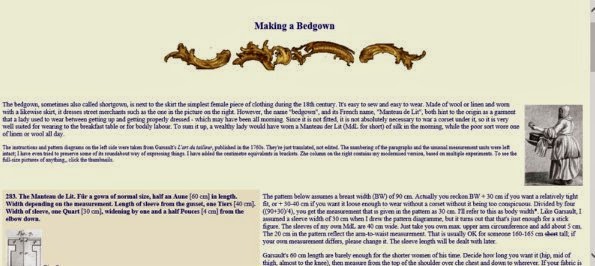
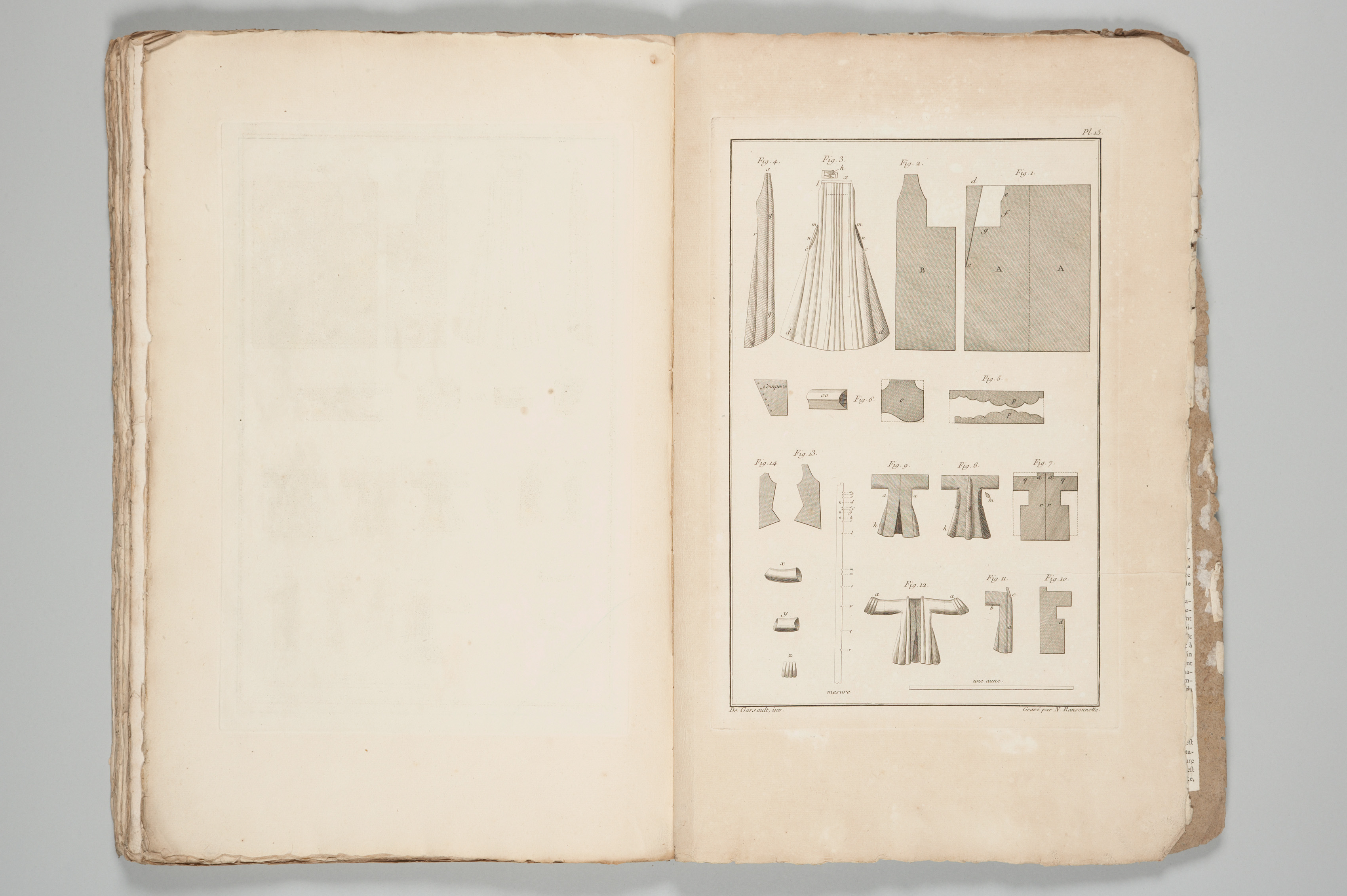
My starting point will be instructions and illustrations from the classic document - Garsault's L'art du tailleur, published in  1769. ( the whole book is online courtesy of Bunka Gakuen Library.)  I followed it as fig 10- the cutting outline, fig 7 - the cut fabric,  fig 8 - the inside back showing centre pleat and side pleats in place, fig 9 - the front assembled, fig 11 - creating the collar and 12 shows the completed coat.
 
Fortunately, having tried to read a little of the original I found a real life line -  it does everything I wanted to, does it clearly and with pictures! and it's called " Making a Bedgown".
    
Marquise - making a Bedgown
 
 
  She has set out her interpretation alongside a translation of Garsault, phew indeed. Mine will be based on his description but not try to follow it exactly. Even the initial layout is a slight variation, he begins with his shoulder fold above half way – cuts the front opening up beyond the half way point to the back of the neck opening,  then re folds on the half way mark to cut the sleeve and bodice shapes. I cheated - marked halfway up the fabric length and then simply cut the opening to 2 or 3 centimetres beyond it, did the back neck cut and then folded.
The image shows the shapes drawn up on a scrap of fabric- not exactly a 'muslin' but it was a trial piece to check proportions and placement.  Red is for cutting, blue is the shoulder fold, yellow the back and side neck cuts.
Construction was very straightforward – a back box pleat from neck to waist - would allow for ease and arm movement ( if Gwen moved, or had arms) – one line of stitching. The neck had to be widened again to allow for this and the extra cuts back to the shoulder line were made then.

The most evil part was next – gussets under the armpits- Garsault calls the wedges?- I have lived most of my life in blissful ignorance of these things but no more. What was worse I wrestled them into submission and then decided to undo and reduce in size. To try to develop some empathy they are now called Horace (been reading Pratchett again).
 
There is one in there somewhere - the new game of spot the Horace.

 
I left the full width of the fabric on the skirt to make the hip pleats, so having sewn the skirt seams then folded the excess into double box pleats and sewed them in place. Fairly standard practice.  The front edge was folded back on itself to make a false robing ( G says pleats) and a small section added across the back of the neck to complete the shawl collar. The offcuts from under the sleeve were pieced and added to extend the sleeve.
 
  Hemmed it and it is done!  At its most simple this is a very easy and quick sew. Nothing fancy at all, and it gives a robust, useful  short robe. No exceptional skills or precise fitting were required so no wonder that it was so popular as workwear. The cutting layout is so straightforward and economical it would appeal to anyone on a budget. But....  Then added cuffs. Then played with fastenings, and removed them again. Then thought about aprons. Then set up a la Hogarth.                                            Why does finishing take as long as starting? It should all be downhill by now.
 
The gown feels quite alien in a way. Everything else has had to be fitted – even the sack backed pet en l'air had a tightly laced bodice lining underneath. I think mine is just a bit too long (stand Gwen on a box was the first response to that one). The fabric mix is a bit off – they are both from the pillowcase stash- but actually work very well together in black and white, hence the pencil study ( a la Ingres). 
 
  In most of the photos it is pinned or belted - and does look a bit like maternity wear, so when trying to match Hogarth's   I pinned some ties at the waist and pulled hard. Surprisingly the pulls and creases are very alike.


Key questions of the week – what was a bedgown ?   and could this have been the garment in the Hogarth painting?
 
Well I could hazard an answer to the first one but with all the usual quibbles about there being no single definitive answer that covers all eras, countries, functions.
 
As for the second -1741- were these around then? Garsault published in 1769 so they must predate then. One site said not before the 1760s, and a couple of the American ones point out how difficult it is to date or attribute accurately. These were not the kind of garments that were preserved or documented extensively. I like the practical evidence though - the pulls at the waist are horizontal and follow the same pattern as in the painting without any tweaking.

The honest answer to the second question will have to be – maybe.

 Hogarth - BBC paintings-  http://www.bbc.co.uk/arts/yourpaintings/
http://digital.bunka.ac.jp/kichosho/file/No.225/225-0000-048.jpg