Showing posts with label Regency. Show all posts

Sunday, 20 April 2014

white pelisse


Of  lovely April days, invasion of cat,  white pelisse, and other many distractions. This is the blog as it was meant to be!


Last week-

The making of the white pelisse-

The sun has shone, the grass and weeds are happy. The bees buzz, there are butterflies, the garden is in its purple Spring phase.  I might have been distracted from costuming but I have been refining copies and interpretations of fashion plates to show the latest additions to Gwendoline's wardrobe as well as constructing 18th Century items for myself, so it has been busy.

I decided to use a clingfilm  base and made Gwendoline a masking tape shell. This was sectioned into pattern parts and then cut and flattened to create templates- and it worked! There is very little gaping, or bowing, or pinching – all without any fiddling, adjusting or cheating in any way. Umm, wow. Don't worry, it won't last.


This of course has lead to unwise decisions, there is no point having patterns that will only fit once, I wanted to find out how flexible this approach would  let me be – 1820s shapes- lower waist, broader shoulders, exaggerated sleeves and decoration. The fabric is curtain offcuts – trying to look like a heavy weave cotton or linen but I'm thinking that the closest this has come to nature was being sat on by an invading cat. ( I yelled, it went from snooze to panic in one move, did a complete circuit of the kitchen tops and windowsills at full pelt before escaping out the backdoor, fled through the hedge and off down the road.... leaving me with hairy fabric and chaos!)

 One idea arising from the gingham frock (last week) was using the smocking as a substitute/sculptural form of gathering, so set out to try a Juliet style sleeve with the repeated gathered bands down the arm. I also wanted to do more with pleating on the bodice. Even my favourite pelisse has gathers above and below the waistline. This fabric is quite stiff, it will bend and flex but goes clumpy and lumpy on curves and bulks up very quickly. The pleats in the back look good but have left the waist heavy, a wider waistband than originally planned might be needed or else the waistline is going to end up the thickest part of the whole garment!
last week's progress


Having faith in the pattern pieces makes such a difference – and saved so much time. No repeat fittings, unpicking and realigning. Getting from 'what shall I do now?' to having a believable bodice took less than an hour. The smocking took about the same. If I had a brain I would have done the smocking before making up and attaching the sleeve. But the sleeve was a bit of a guess, I knew I wanted more fullness at the back rather than the front, and that Pingu arms must be avoided. So I began with a basic gathered sleeve shape and made the curve at the top steeper and off centre . It did take some minor fiddling as the fabric protested about curves but it sits reasonably well, although many sins may be lost in the puffiness. And of course the piece I cut as a pattern is now firmly attached !.
 

This week-
Overall the pelisse has worked quite well- the good times did not last  The collar was a problem, it still tries to stick straight out rather than relaxing on the shoulder. Repeated washing did not help it, the fabric has a great deal of 'boing' - it tries to reset itself to flat each time. The radial  pin tucks have helped  a little and something to experiment with later on. Fears about the waist at the back were well founded, it is thick and seriously needs stiffening. Perhaps come at it from the end - put a bow on the  waistband cb so the bulk becomes deliberate ( see little blue example above).
  I do wish this stuff would make its mind up - it bends when I don't want it to and is too stiff when I want it to bend.

 As a relatively plain pelisse it is fine, the gathers in the sleeves give it more character and style. The gathering on the centre back  should perhaps only be attempted with finer cloth. Poor Gwen does not look terribly happy it. It does nothing for her figure - the extra bulk on the waist is not good , there is nothing voluptuous or even jelly-on-a-plate-ish about her to give definition, she ends up looking like a tree trunk. In the plates above, the waist is so narrow in comparison to the shoulder/ sleeve line, and  Gwen goes in just a little and out not a lot. I do wonder about making her a set of stays /padded bodice-  can't pull her in but might be able to push her out. ( I'm sure I thought this before sometime - a little set of transitions with bust enhancer?)

One moment - repeated washing?  Knowing how much I enjoy domestic chores  you will have realised this had to be an emergency. Well, first the 'sharps' needle I was using was very sharp and I hadn't noticed, second time was due to creating drawings in pastels. The washing has caused problems, now the lining is not happy at the armhole, causing the wrinkling seen above, a bit of unpick and pull  will hopefully sort it but this garment will remain untouched until the pastel phase ends.

Distractions-
1. Pastels- not a medium I usually use but... apart from the dust .....they are quite fun.


2. The fake book. - it started with a charming photo posted on facebook from the Australian Jane Austen Festival in Canberra.  In the general flow of very learned conversation we decided the photo looked like a book cover, couldn't resist it, and....  Last time I caught up it was either Mr D would emerge a la wet shirt, or she had  just shoved him in.  The drawing took  over a morning and then working out the editing  programme took about the same. (Gimp2 - a free download, complex but very good)


3. Gave up putting it off and set up a website- AARGH.
 
  Pastels were easy, Gimp is straightforward. If I had known how to do this it would have been simple! Used Google sites, free, supposed to be an easy site builder, self hosting, and well I'm googled for almost everything else. Looking back, once the mind shift was made, it was straightforward enough.  Over riding the templates was the most frustrating thing - typing in black, size 12 in default font to find it published in blue, boxed in a corner and.......
Hopefully all sorted, hopefully,.... Feeling very exposed at the present.  Be warned - will have to start experimenting with promoting it next....
 
 
And totally recommend
BBCs   "At Home With The Georgians: A Man's Place. 
So much more than important people and oh look at the houses. Well done to Amanda Vickery.


Sunday, 13 April 2014

A little sewing, alot of pastels.

So this is not the post I was hoping for - that was even drafted and photos done.... and then.... distraction struck with a vengeance. Here are some tasters/teases for the real blog, construction, more smocking, fashion plate......
 but this is the one you are getting.
Let me explain - Started the new idea on Friday, tried a new way of drafting the pattern - worked well. Using up some fabric stash- brilliant. Went together sweetly, even embellished according to plan. Suspicious? So was I. Only things left to do are finishing the lining, applying the fake waistband (cut, pressed and ready) and fastenings ( set out and waiting). This was obviously too much to cope with. It felt like being a real costumer - even had a cat invade and sleep on the spare fabric. So of course got distracted, by a nose.
 It was too long, like a beak,  it was looking at me, and had been looking at me for most of the week. While the kettle boiled it could be sorted - that was breakfast - it is now lunch. Sorted that nose, done another and sorted that too.
So I'm always doing painting and drawing along side the sewing but this was a pastel work. For anyone who hasn't used chalk/soft pastels they are a rare species of demonic life form. Never get the exact colour, or marks in the right place, and  they conspire and giggle in the box just waiting their chance. Not too bad, until you realise the amount of coloured dust they spread happily over everything, the cutting/work table, the floor, me. It isn't just any old dust, this is friendly dust, wanting to get really close and stay with you for life.  Not the place for a plain white anything. I am actually going to have to WASH UP to get it  off my fingers. This is traumatic.
The new garment is on hold until the table is wiped down and dried, everywhere hoovered  and clean.

What I will share with you is the cause of all the trouble-  a study by Adolph van Menzel.
von Menzel

Watteau
 It has the same informal charm as the Watteau studies and is an unusual, beautifully lit  pose. I can't decide if she is being coy or looking for goldfish.
After a couple of pencil tries out came the evil pastels and battle commenced. They are actually quite fun to work with  and working on a coloured ground was a change - the colours are bolder, the paler tones are more vibrant, but they mix in unexpected ways, sometimes clear layers, sometimes muddy, chalky and opaque.
initial working
Having got this to a reasonable place it was pinned to wall (gently shedding dust) for a few days so that I could evaluate it and plan the next stages. It really was the nose, and elbow, and claw hand, and skirt detail.
It was going to be a quick amendment, no fuss, no mess, no trauma. It was. And then the 'should I do a background to balance the composition?' decision. And then came the 'while the pastels are out....' moment.
The Yellow Dress.
  The dress is the yellow gingham made and posted about last week. I haven't tried to  be pedantic about the gingham pattern, focussing more on the shapes and fall of the skirt. This is a very different outcome to the 1824 fashion plate pose done to previously. I  like the idea of presenting my Regency creations in as Regency a way as I can but I do like the  substance of this- is does make the fashion plate look over precious (but in an entirely charming way. Of course).


The second image is  based on the Scarf/shawl dress from the week before and is the development from the "Regency Wedgie" pose as discussed on facebook and pinterest. It was too good a thing to pass up so I had added a quick sketch to the mix and this grew out of that.. After so many still poses this was meant to be dancing ( just about turned into the 1960s/70s flamenco pose) and she is holding her  over dress rather than adjusting the underwear!


shawl dress with initial illustrations


They have turned out better than I expected, the shawl dress needs more attention, but pastels allow for a combination of approaches - the directness of pencil mark making and line, and then the more painterly handling of surface and colour. They have made me work larger, more quickly and to be bold in the use of  the limited choice of colours that I had, forcing me to be more experimental with  mixing and contrasts. The coloured paper puts more emphasis on working with light,  which I have probably enjoyed just a little too much. The water colours are still the choice medium, there is so much still to develop there. ( They look better in the flesh - more subtle, and softer) but these have been fun! And messy! And now to clean up....... or should I have a go at the dancer first...to save cleaning up twice...... how about the far shoulder of the yellow dress- should be puffier.....
It will be tea time soon.

Sunday, 30 March 2014

Regency shawl dress, Gwen shall go to the ball!

I claim no responsibility for this. A query was posted about using saris   to make a regency style ball gowns, they are a good source of fabric, richly decorated  and often excellent value. The responses cited the trend for dresses made out of the imported Kashmiri shawls in the early 1800s, something I'd known about but not really considered.
I just happened to be in a charity shop getting my breath back having cycled into town, it just happened to start raining so was reluctant to leave, there just happened to be a silk scarf of a sort of  Indian design, sort of the right size, so I bought it, and this happened......

Context first -  there are many pictorial and extant examples around, the shawls were huge so offered many options from the drapey Greek style chiton approach to using as a standard dress length of fabric.  The fabrics varied as well, from fine cotton and silks to heavier winter weight wool. The first blue dress was the one that began this little episode, from the Snowshill Wade collection dated 1815 and documented by Nancy Bradbury in "Costume in Detail". The second image is merely to show the volume of fabric and the ornate border of a shawl, the third is an 1810 dress from  Museo del Traje and  the blue print ensemble is  Empress Josephine's ( not entirely sure if this was made from shawl lengths or  fabric printed to look like it, one site is sure, another is not! but it has the same feel of using the imported pattern). They all make use of the borders and trims  especially around the hem and neck. The fashion plates show much the same  story but with more accessories, more ornament, layers of detail and pattern.
 
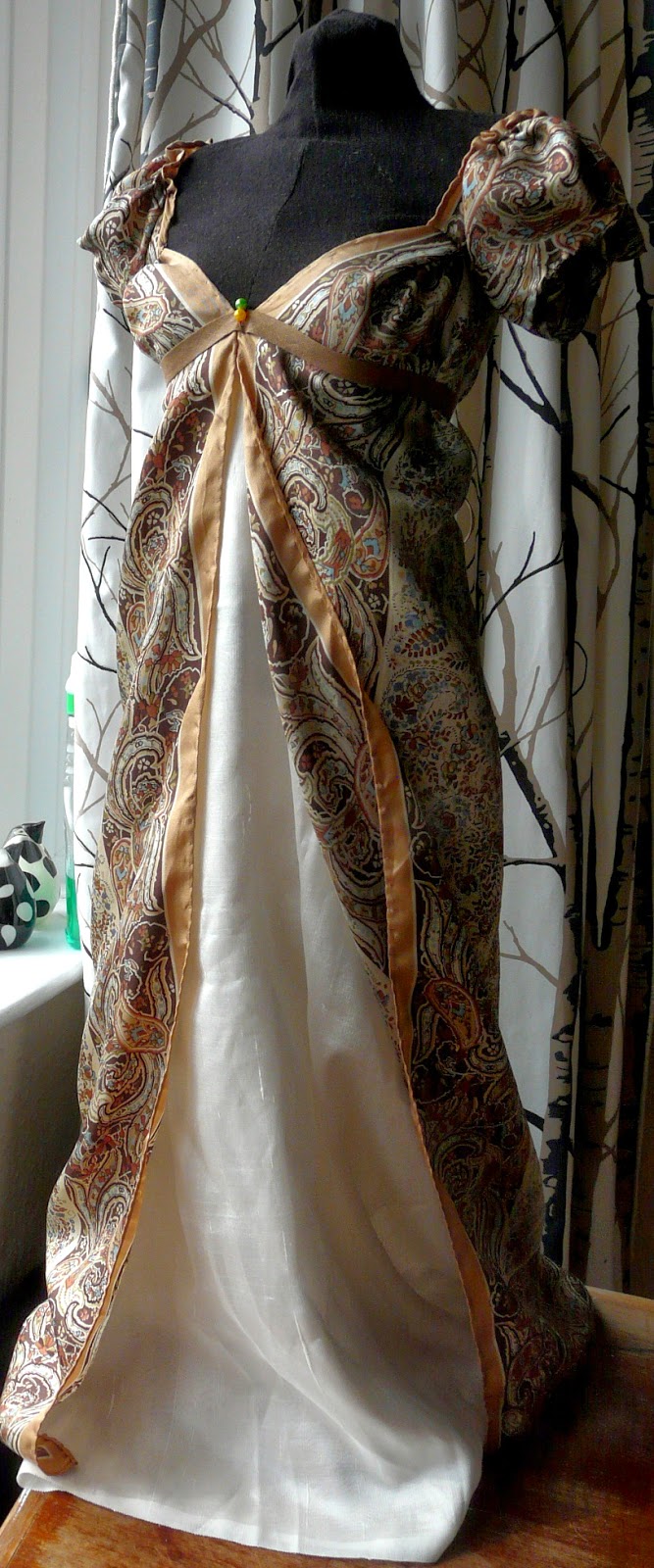
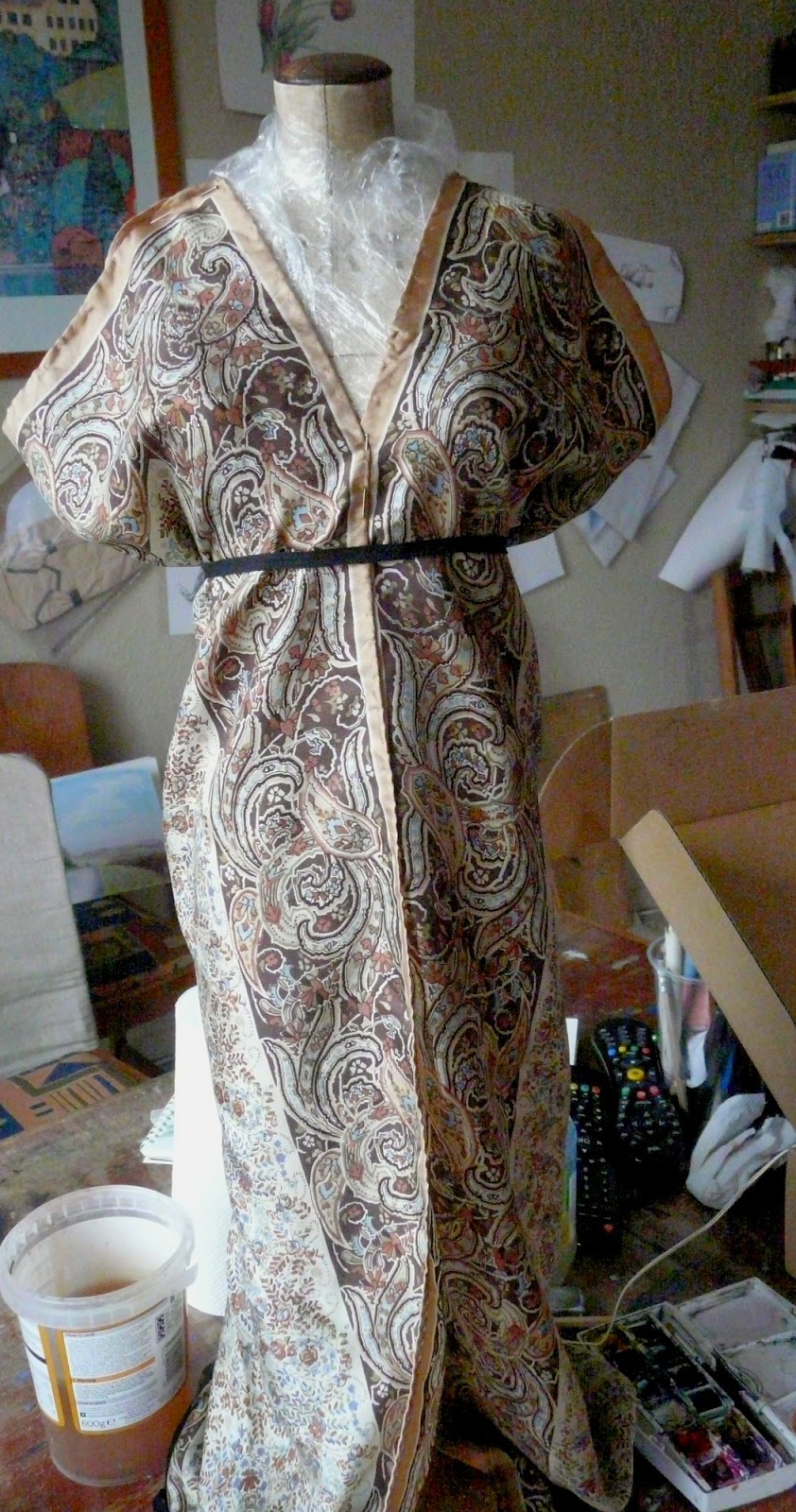
The original shawls were long rectangles with ornate ends but mine was a 30" silk-ish square with a printed border all the way round. A garment for me? No, remarkably draughty. A garment for the faithful Gwen. To the right the scarf is  folded into the centre and pinned at the shoulder to give a very basic drape. The challenge will be to stop it looking like a dressing gown. I like using the border  in the centre of an open dress but Gwen needs much more help and structure to give her shoulders, somewhere between the profiles of the  green and first red fashion plates.
 The dress is fairly simple, the only cutting was to take off the top border, This reduced the length and gave something to make the sleeves out of!
 
There are 2 rows of gathering to create the bodice, on the high waist line all the way round from border to border and at the centre back along the top edge. The front is joined at a point 3" down and the very top of the front border is pleated back onto itself to give the separation at the bodice.   Each sleeve is half of  the sacrificial top border, sewn into a tube for an inch and opened flat along the top of the dress and  attached. They are gathered at shoulder and cuff trying to give that extra breadth  across the top line. I did reserve some of the yellowy border to do the front trim but it has escaped at the moment, so a length of elderly bias binding is playing understudy for the photos. It gives better definition to the bust but is rather clumsy  tied at the back. If I can't find the renegade trim this is all I have left of the fabric to work with - wish me luck!
 
And the most important question of all - Does this make Gwen look less like Juno, athletic and wholesome, and more of a siren, has she achieved cleavage? 

Certainly like the wider shoulder, even if they had to have stuffing shoved (romantically) up the cover to stop the sleeve slipping off. The back is a bit too much, may be lose some gathering to the sides. For such a straight forward idea this has not ben easy. Getting one side to work was simple, getting the other to match was a pain. The fabric was lovely, to look at, but had no substance. It lost all shape and form unless it was on the model so that was how most of the sewing was done. If I was making this for real the seams would be taped and the bodice mounted onto a lining.  I must take a pattern from this and try with a more meaty fabric, with some adjustment this could become another Gwen wardrobe staple. At least it is her very first grown up ball gown. Not bad for £2.49  ( cheap date).

Some useful sites-  There are loads out there, but will there ever be enough time to read them all?
http://historicalclothinganduniforms.blogspot.co.uk/2012/03/not-only-shawlshawl-dresses-and-dresses.html
http://thedreamstress.com/2013/01/the-kashmiri-shawl-and-the-dress-made-of-kashmir-shawls/

http://www.fashion-era.com/regency_fashion.htm
http://www.marquise.de/en/index.html

Monday, 24 March 2014

making the mob cap

Georgian/Regency cap

Apologies for the tardiness this week - just trying to get the world to behave a little!  Failed. Gave up and am just getting  on with things regardless. And moan. And moan. Comfort eat. And made this as a by-product.

This week has been a very 'shut up and get on with it' one. I've had a chemise pattern for a while and was determined to make it. This is bread and butter sewing not cake, lots of straight, precise fell seams on a garment that was never intended to fit. As one who does not convey ideals of elegance and svelte willowy form, for me this garment had all the charm of a potato sack.
Being a good little beastie I even measured carefully and followed the instructions. Hah. Should have an ease of 12" over the hip not 20".  "This is a good time to finish your seams, if you have not already done so. The original has been entirely finished with small flat felled seams." And that is that covered. I have never tried felling intricate  'Y' junctions before, don't really fancy doing them again, not without more advice or medication. The great white whale is done, it will do until I've got my mental breath back and can face redoing the  dodgy bits. You may guess that I am not truly happy with it.
This left me with an aftermath of a floor, Furniture all over to maximise the floor space for cutting out, bits and remnants taking up residence, notions escaping, and sniggering in the corner is the machine and iron. So what to do? Bright idea, I'll make a cap out of the left over fabric, that will really help to clear things away!
So....
I've made the panto version (dustbin lid, elastic and ribbon- 10 minute task once started!) but this was to be a more refined form and the whole purpose was to make an exploratory piece to sort out shapes, sizes, design and construction  for future reference. As an adventure into The World of Caps this was a sewing machine job for speed with hand finishing if it came out right


The basic model - a version of a mob cap, frill as a peak, band and then the cap. Very simple, lots of variations. Standard indoor wear for wealthy widows down to the servant help, fashionable as well as utility. (The very funny ones are those perched high on top of the towering wigs, still with a pretty bow) So many examples are on pinterest  that I spent far too many an hour longing,  looking and worrying.
liotard -
Begin with identity crisis, what is my social status? To decorate, to froth with lace and ribbon or to be sober and plainer, cheaper. Seeing as the chemise fabric was the cheapest cotton I could find I think the cap certainly won't be of the posh variety.

Scale - I am not good with hats so something to hide/lurk in or that could be welded in place is a must. Of course at some periods caps were worn under a bonnet or hat, so this could be phase one of head wear.
 

Up to this point I was fine. Some fabric had left the floor, so had most of the pins, one pair of scissors and a tape measure.  Rough pieces were cut - long 3" strip for the ruffle, a band tapering at each end to over the head and a tall semicircle for the back. Simple and straight forward.

 Then..... Couldn't decide between narrow knife pleats or broader box pleats, so made one of each. Liked them together- why not use both?  The frills were sewn to the front edge of the band and tried on.  The moment photographed is the one of Hope Triumphing  Over Experience. The  pleats are full width 4" and seem to give an exaggerated ruffle, too much like a cake paper.  That I also looked like Mrs Tiggy-Winkle  crossed with Toad escaping as a washerwoman rather than a simpering Regency Miss, did cause concern. The pleats were reduced and layered as shown but I did  it the wrong way round! Redid with the box pleats wider than the other. These are forgiving and fairly open so with any luck the tighter knifed layer should stop it from flopping too much.. There are many paintings and extant garments to show that this double frill was acceptable but usually with the narrower band uppermost. By the time I'd finished these strips had lost that lovely crisp whiteness of fresh cotton, they are scarred, mangled, abused but still trying.


The  cap back was a horse shoe/ tall half circle, the bottom section folds up to make a drawstring channel. Not sure of the size needed I started off with 17" diameter and prepared to reduce. It was gather-stitched and pinned onto the back edge of the band and adjusted. When I thought it was fine I sewed the seam really,  really carefully but....
the back cap was still too full- positively bouffant, probably fine for the 1790s, but not a look I am comfortable with, so this was removed and made narrower. (By 'removed and' I mean unpicking seams, unpicking gathers, pressing, measuring and marking, 2 lines of gather stitch. pinning at the quarter and eighth marks, gathering to fit, sewing a new seam, removing pins and then pressing the seam open. Again.)

Major construction is done. I went with a band sandwich, duplicate band pieces top and bottom, holding all the seam allowances safe and out of sight. This was hand sewn - it felt so good just slipstitching along, and now the creation is created!


It isn't shaming but there are things I would change - the back is too long and could be gathered up more. Perhaps the outer frill is too wide still?  The knife pleats are  vicious, too rigid against the outer layer so they don't complement each other as I hoped. A run through the wash could work wonders as the fabric isn't pre-shrunk! 
As a cap it will do. I have a better idea of the process and adjustments. Worrying thing - still some fabric on the floor, would still be enough to make a cap........ and I do like the sans-frill carcase picture above. (Millicent could sell anything).  Remembering   "The Mirror of the Graces" advise I should be careful not to over embellish as a lady in the advanced seasons of life!

And, no, at this time I am not going to publish photos of me wearing it, content your little souls  with Millicent the Milliner's Dummy posing serenely for you. If you don't think I suffer enough do take into consideration that I have to tidy and resurrect the room for the art class tomorrow!
  I hate housework. Might find the other pair of scissors.

Monday, 30 September 2013

Gwen's indecent muslin part 1


It is ages since the last post! So lots to catch up on.

Experiments were done, the Marie sleeve shown on the Gloucester wedding dress was rather fiddly but effective, why the sleeve top is done in two sections I can't see, having two raw edges gathered onto a narrow band did get a bit much, but perhaps the scale just made things worse! I wanted something easy to calculate so just measured off the pattern in centimetres and drew out inches, perhaps more pain at this stage would mean less pain later. The sleeve head is huge against the bodice, there is no stiffener in mine but still stands out quite rigidly, but the real thing can't have been easy to wear, but then contemporary wedding dresses tend to be exaggerations, so was this the same?


I sent a speculative email to Gloucester museum service and had such an open, enthusiastic response – I can go down to work from the original garment! Just short of 400 mile round trip to see a dress, why am I so excited by the thought! Hope to arrange to visit by the end of the month!


The main reason for the delay in posting was another good idea. I don't really like Gwendoline's party frock so have begun another, an ambitious project – a low cut crossover bodice of muslin mounted onto a lining with a round skirt. I wanted something a little more sexy and fitted like the Lawrence portrait shows to see if this will show of Gwen's shape better. Of course it couldn't be done simply so I wanted the lining to hold the form and the top layer to be gathered on the front to give a more romantic wispy effect. The bulk of the bodice is done and the skirt is tacked in place, gathered at the back with some gathering at the front under the bust darts.
This does help the skirt to hang well in the round but looks boxy at the waist line so it will be untacked and eased around the front.   It will definitely need an underskirt, even this quite coarse muslin is indecent. This didn't take long to do, so confession time. I had a go at some embroidery on the hem – giving a bit of visual weight, following ideas from the 1805 muslin dress and stealing elements from the designs published in the period journals. My design is a simple Greek lyre shape, full motif at the front and halves repeated along the hem and onto the back seam. This took for ever, please note – embroidery on flimsy muslin is a pain of the highest order, lines along the grain are simple but curves and satin stitch! It will look fine but the tension changes as soon as the fabric is realigned in a hoop or just handled. Out came the modern threads and I have redone it all in fine silk. It does look better than I thought now the skirt is on but this was nearly sob into the cornflakes status. How they did this on delicate muslin and so densely as on the dress to the right I dread to think.

The sleeves I want to be extravagant – probably based on the Marie experiment rather than the tight ones with high sleeve caps as above. They should be dramatic, to frame the bodice.  In the painting I've gone for puffy, almost bouffant sleeves but need to work from life to get it right, so I guess I'm committed.
 
  I've just thought that the sleeves should go on before the skirt! Aaaaagh! Am I really doing this for fun?
And just for more fun I've found some generous and trusting people who will let me work from their photos of costumes being worn! But I want to complete this dress and images for next week's update
 and start my drawing classes, and crochet hearts, stars and snowflakes and..... and....
How was there ever time to work?
 

Friday, 13 September 2013


Gwendoline's party frock.


I'd been given some pretty offcuts a while ago so decided it was party frock time. The fabric was quite stiff, frayed happily, and has trailing flowers embroidery which can be awkward in the seams. But that is the up side. The embroidery is not really period at all but did remind me of an example from Worthing using fine embroidered Indian muslin.

Worthing. 1810-20s.
The fabric is in long narrow strips and doesn't have the drape and hang of the muslin, so I went looking for styles from 1815 onward rather than the more pure NeoClassical look of the early 1800s.


 I hoped to make a  high waisted dress with a panel of pleated gathers on the bodice front, fastening at the back, with a gored skirt. The neck was to be embellished and the sleeves short and open to reveal an undersleeve in contrast material. The hem would be decorated and possibly stuffed to give the 1820s rounded shape to the skirt. Both of the plates below show  the wider flared skirt, the fitted bodice and lot of decorative detail. The necklines are wide rather than very low, both accent the waist with a ribband.  extant dress is from the Met collection, the padded hem is clear and holds the skirt out from the feet. Perhaps the mockery of the satirists had had its effect - take a look at the 3 Graces in a high wind by Gilray!


Problems – fabric. It has a nice sheen but resents being folded tightly, the bodice front is rigid! Top sewing on the neck did help but it tends to do its own thing given half a chance. The same problem with the sleeves, rolling the edges to create neat mini hems was not happening so I ended up facing them and they stood out rigidly like bat wings instead of falling gracefully . Research to the rescue! 1820s seemed to delight in layers and contrasts of textures and concepts. The tight bodice with the massive exaggeration of the sleeve, the simple dress with great embellishments at neck, arm and hem. The purity of the Neo Classical hadn't lasted long. In the Janet Arnold are several examples of pleating, gathering, slashing or opening to reveal an under layer, Renaissance influenced, and of mixing fabric surfaces, tucks, cording, using lace.   The 1827 Snowshill and Gloucester examples have so many ideas!
 I had already started on crocheting a heavy lace edging for the neck, close to the dress colour but the satin sleeve lining and waistband are toothpaste white. I made a butterfly in the crochet lace to hold the sleeve together over the lining to defeat the bat wing look but was doubtful about  white and cream together, but it does seem to work,
 This left decisions about the hem. Made the decision to try out the Gloucester Museum wedding dress decoration in scrap fabric and to a larger scale. Thank goodness I did! This just eats up fabric. The top piece is on the cross and uses double the width, I don't have any where near enough fabric to do this for the dress! The top and bottom are bound in satin on the original, I just used some left over cotton bias binding- again far more than it looks, all those vandykes are a trial. And the time!
 Looking at the pattern it appears simple but this doesn't work, to get those rounded gathers they have to roll under and then emerge flat to link to the next repeat. I have got close to the original but am not yet happy- do think it looks a bit like a curtain pelmet.  While I would like to try this for real, but not with this embroidered fabric.  It is just not flexible enough for anything like these so the compromise queen swung into action again, I tried the stuffed rouleau hem to see how this does affect the shape and hang, added some extra texture with a larger version of the neck embellishment. The compromise does not look out of place but is a bit plain, perhaps another crocheted row or two would do. The hem maybe over stuffed, the wadding makes the hem stand out stiffly and always wants to make circle. As the skirts got wider it must have been like a bumper car convention. The technique  is simple enough but is unforgiving, the hem has to be absolutely level and hang symmetrically before starting.
 Review-  too safe. Enjoyed the experimenting but as soon as it becomes a garment it goes tame. This began as the same pattern as Gwen's poplin dress, it seems to be a decent base so I could afford to be more adventurous.  Perhaps time spent doing experiments rather than garments could be wise. Extend the range and then try to apply it?
 Next challenge- a printed day dress. The fabric is soft but dark, so pleats, tucks, flounces, contrasts. I've been roaming museum sites, blogs and pinterest, so goodness only knows what is going to happen! Perhaps if |I put the Janet Arnold books under the bed I shall awake infused with that knowledge, experience and know how!