Showing posts with label Gwendoline. Show all posts

Monday, 25 August 2014

bustle dress beginnings.


This about draping, drafting, fabric buying, sore feet and getting it cut out. Oh, and Gwen now has a bustle petticoat.
1885 by Mrs Christie of London.
Task- select and source the style and shapes relevant for the 1880s, drape it on the stand over all the underwear we've been making, draft this into patterns, make a toile. and fit it to ourselves. then Work out yardages, set a budget and go buying. The chosen fabrics are now cut out and mostly flat tacked onto calico, waiting to be made up!
Hermitage Museum
I went for a day dress based on this little petrol blue number in the Museum of London. Not the bodice front but the skirt - asymmetric layers, contrasting fabric textures, so lots of interest without shouting about it. The worrying thing is that it is not relying on embellishment for impact but on the fabrics and cut - nowhere to hide. What is good is that the front and back are balanced - there isn't a distinct front and back separation. The only problem is the front seems  intent on broadening the shoulders and bust to narrow the waist - I do not need added emphasis in this area, so went looking for a different frontage - Maria Fedorovna (Dowager Czarina at the time of the Russian Revolution and original recipient of the Faberge Easter eggs-) to the rescue. This was an evening ensemble = red underdress and beaded over gown. Not at all compatible but I liked the shape of the front!  When mashed together it just about works - something like this.
The whole was to be draped on the stand in medium calico - working directly onto the mannequin without a paper pattern. To break us in gently we began with the foundation skirt to cover the petticoat. It was supposed to be simple - use the petticoat pattern, allow for the extra bulk from all the frills, the idea is to cover the petticoat with minimum fuss and without squashing or losing the general shape.  And construct. And then remodel it when the waist fits but the bottom doesn't.

foundation skirt, draped apron and bustle
Very little of the skirt is going to be  visible - just some pleats at the bottom.  The velvet apron fits smoothly over the skirt so the same pattern shapes will be used.
Then it was onto the radical bit - the draped apron hanging from the right hip.  This was a fairly drastic  60" square  at the beginning- on the cross- with the top corner cut off to make a waist.  It is now shaped like a rough map of Africa. The front edge has to hang in folds and the back is pleated high over the bum. Just to make life fun that front edge appears to be rolled under so the folds come from behind. Happy hours of muttering, pinning, more muttering and it was done. pinned, tacked, and oops - the tacking affected the hang so start again.........
On top of this comes a bustle piece - just a rectangle for this and caught up on tapes ( rather like an Austrian blind). It should have been asymmetric too but looked most odd- not quite big or bold enough to look deliberate without giving me the lean of the drunken sailor.

pinching pulling and pinning, shaping the fabric around the form to match the photos. First pattern.
This was meant to be the easier bit because now came the bodice - starting with a vertical centre front, pinning above the bust line and to the side and then pinching the fabric to create front darts to shape it in front.  The back is separate pieces- centre start and carefully mark first seam running up to the armhole and gradually build on the next side back pieces making sure that the grain of each piece is vertical. Sleeves were drawn up  as a basic block pattern and the modified to give upper and under pieces and the bend at the elbow. The front shirty bit is mounted onto separate little panels which will meet edge to edge as a closure, a bit like an  C18th stomacher.

Once happily pinned together on the stand, the edges of each piece were marked, removed. cut down to an inch seam allowance and it was made up and fitted on me - Ah. lots to play with - the two darts  have changed to a seam running up to the shoulder and a dart. The side of the front has been split in two to raise it at the waist, and the shoulder seam moved. Redrawn and remade and refitted.

the early front with frothy bit, final back, sleeve, and the revised pattern
Once the whole was satisfactory, the patterns were drawn up and yardages worked out - about 15-16m in total, in 4 different fabrics! - something plain for the bodice, bustle and foundation skirt (was hoping for something like silk twill) something understatedly fancy for the side apron (a fine damask or brocade?) velvet for the flat apron and cuffs, plus a contrast for the fake shirt front - lawn or fine, slippy satin?

We went down to Goldhawk Road- next to Shepherds Bush in London- on a buying mission -

drawn en route to Hammersmith!
 lots of lovely stuff, especially silks, but trying to find 3 key fabrics each with interest and who work together without arguing  was definitely a mission. It would have been easy to be completely safe - but I could have stayed at home for that, and the Victorians were 'robust' in their ideas of colour and pattern. Bit disappointed not to find a plain brocade like a fine damask for the apron- or even a matching stripe would have done,  and not to be working with delicate tones of brown pink or sage green or muted blue - they proved impossible to match and the mixing was horrible. So came away with a muddy greeny yellow silk, kind of a Prussian blue  velvet, crinkle gauze in yellow and blue and plans for white lawn for the fake front. Umm. Could look like a railcrash or could work really well. The two tone gauze is the jam in the sandwich - it will tie the two strong colours together and hopefully really give the flatness of the velvet some bounce and enhance the sheen and colour shifts of the silk. Umm.


not the true colours - less greeny but sadly shiny


We came back late on Wednesday, cut out on Thursday, spent Friday cutting calico and flat tacking it to the silk to support and stabilise it. Far too organised, so I managed to stab myself and bleed all over a skirt panel, squeaks and drama - don't mind me - save the fabric! Never mind.


As for Gwen - couldn't leave her out - returned to Goldhawk and bought a piece of dodgy second choice fabric to make her a bustle gown and then spent part of Saturday making a petticoat to go underneath it. Need to choose a style now - the rejected House of Worth green thing with train? Umm

Other distractions -
M&S swiss rolls.
Wandering around London at dawn(ish) and dusk - saw the Tower of London poppies, Phyllida  Barlow at Tate Britain, Breakfast in Russell Square,  went to say hello to the Lion Hunt relief carvings in the British Museum, found a great little foody street market behind Westminster, wondered why my feet are sore.
They still have low flying pigeons in the new sanitised and shiny King's Cross.
So many pin pricks now feeling like a tea bag.
Don't leave car and house keys  in unzipped pockets when hill walking - result = blind panic, having to walk the hills twice,  collapsing in heap when found them without any energy left other than for a very feeble whoop and slight waving of limbs. ( they were right on top of hill of course - at least it was down hill from there)

Emsay Crag - now known as carkeys hill. Thank goodness didn't go up Great Whernside as I first planned!


Sunday, 10 August 2014

frock coat for Gwen and Lotherton Hall.

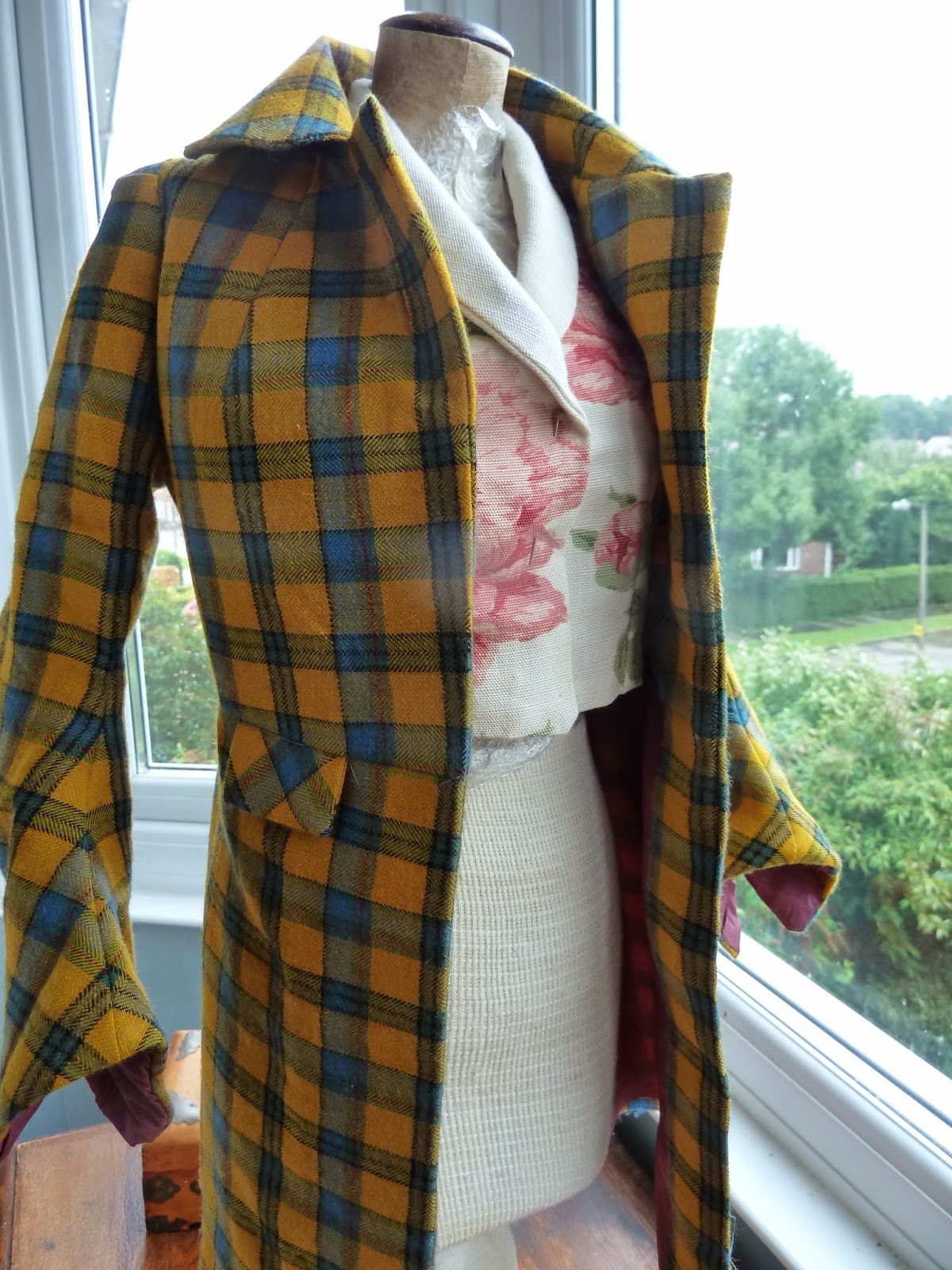
This has been a 'reading week' at the costume course - officially set aside for research.  I set aside part of the week for a revision of the frock coat, so Gwen now has a mad Rupert check coat - just needing a hem and buttoning. This was a challenge - more of one than I thought just matching the fabric! and certain things are not right.  But it looks okay from a distance. Especially in poor light.

Just like the waistcoat this was a mini redraft of the Ron Davis pattern. It was meant to help iron out problem areas and to practice the parts I had found difficult. Didn't work out that way. Oops.

the black and white is in the interests of general sanity
Problem one - cut the first coat skirts with the fabric on the vertical not horizontal  so had to cut a second pair. - this  had knock on effects - the rest of the pieces no longer fitted onto the remaining fabric. This was an old unfinished project so buying more of the cloth  was out. Look too closely and you realise that one back and one outer sleeve are  wrong, the pattern is back to front. It made matching the rest more painful but hopefully doesn't show too much.

This was a menace to make- though not in the expected places- pockets went in smoothly ( yes, they are workable pockets), facings and pad stitching happened uneventfully but everything else....!  The sequence of making still is a bit of an enigma - every option seemed to lead to more problems than solutions. And then I cut the wrong flappy bit when trimming out the excess seam allowances at the back of the arm hole. Unable to cut a new back piece it was a case of make the sleeve fit - which is why there are fewer pleats on the sleeve head than planned  and about a centimetre less shoulder.
The  other major adjustment was to go from sizing it to fit over the waistcoat to just fitting Gwen's torso - over a centimetre difference. This may not sound a lot but the coat was left  looking like a giant tube - only touching on the shoulder.  The major darts down from the collar were the solution- saw similar on some 1940 tailoring - think they look pretty good - or at least intentional.

in full glory


oddly good with the waistcoat?

This has left more queries and questions about construction methods - so probably another Gwen coat will have to be made to sort these out. But not yet.  Definitely not yet.


trouble is - quite like it inside out with the patched lining showing!

As for research......... did extensive practical research into the tides at Sandsend, the availability of icecream, and also tested the extreme steepness of the steps going up on top of the ness. Results were - 1. sea water is wet, 2. prefer Yordale's selection ( rhubarb and ginger or lemon curd), 3. very steep. That was Monday.

Tuesday's research was more relevant - tried out Leeds Museum, the art gallery, the markets, some very posh tailoring shops- don't know how they do it!, and the newish park and ride from Elland Road.  Conclusion -  my feet hurt, and 'interactive museum exhibition' means things to bash or buttons to press aimed at the under 5s, and got  a lot to learn about tailoring.  The trip also involved finding Fabworks fabric emporium in Dewsbury - worth a foraging trip, especially for suitings and  other things than quilter's cotton. Hurrah! Parked in a bramble.
Day 3 - proper job - went to Lotherton Hall just beyond Tadcaster. This is part of the Leeds Museums group- Edwardian house, with a costume gallery (says so on the map).
The house is better inside than out and the costume gallery was hosting 'Dressed for Battle', showing the influence of military styling on fashion.   Not bad at all, Regency dress next to an 1807 Leeds Volunteers tailcoat,  later Victorian and Edwardian  pieces against a Hussar jacket with a sprinkling of Alexander McQueen bits, First World War dresses and of course  1940s things, including a 'New Look' style suit. The blurb made it seem more extensive than it was but it was trying hard and was of interest. As in all museums there seems to be a passion for putting black clothes on display in unlit dark boxes - what is the point? Why display something if it can't be seen? ( worst offender presently is Leeds central) And what about seeing all the way round the objects ?  Finding their blog site could prove a useful reference-  http://www.leeds.gov.uk/museumsandgalleries/secretlivesofobjects/Pages/posts.aspx?BID=117.
 Will admit to spending  a happy half hour with the bird collection -
there were some fantastically  grumpy looking pigeons, a sunbathing condor and a very confused turaco. A diversion? - perhaps not - lots of subtle colour and pattern combinations to ponder on -  The deer were less inspirational - being very deery, and in the deer park not the bird garden. Didn't try the icecream - may have to return.

Were actually meant to be researching bustle dresses and looking for the next inspiration after that. Good job managed to fit it in round the edges.  Still like the grumpy birds best.


Sunday, 13 July 2014

1830s Waistcoat Week!

This was the week for waistcoating... in fact it took far less time than this, minimum button therapy and only 2 icecreams.

Recap - 4th week of the course at the  Northern College of Costume, working from Ron Davis' pattern for an 1830s single breasted, shawl collar waistcoat. Patterns were drafted and toiles fitted. This now is the waistcoat proper....
From the toile the modifications were pretty straightforward, just lengthen at the waist  by 2 1/2" at the front and 1" at the back.

The fabric is a grey blue with a dull metallic broken pattern woven in. It is a kind of twill weave and manages to have very little substance - it's like that annoying friend who only says 'I'll do whatever you want to do' or 'I'll have what ever you are having' and then looks miserable for the rest of the day. The lining is a dull, dark duck egg blue, heavier and more substantial but reverts to floss when it frays. I imagine that any natural fibre content was purely accidental.

The fabric was cut and flat lined with a light calico and interfaced on the front and collar pieces.
front - with pocket!
inside front - facing and lining
After flat tacking to mark the key lines assembly began. Initially it is very clear - pockets (perhaps I should admit to pocket traumas - working out how to set them on the slant and how to minimise bulk, distressingly simple once the penny had dropped),  sew the centre backs to make complete back units, attach collar piece to front, collar facing to front lining, and join fronts to backs at side seams.  From this point on life gets more complicated.


side seams done - looks like bat sign


 I have never yet found the definitive simple way of putting a waistcoat and lining together, it seems I am not alone. This time we  placed rightsides together and sewed  around the armholes, front edge and front hem line. This meant that it could  still be turned rightside out.  The top 1/3 of the front
edge was left open so that we could get in  to sew the front shoulder to the 2 backs on machine ( The front lining would be turned under on the shoulder seam to hide all of the raw edges later on). 
Think the bit in the middle
 is the shoulder seam!
The under collar's centre back  seam was joined  and then it was  sewn to the  neck line. The top parts of the collar were sewn at the centre back and then the
centre back joined and sewn
 in place along neck line
front edge seam completed all the way round.  It did get confusing but was nowhere as fiddly as I thought but..... nothing can ever be that easy - we had misread the pattern a little and the facing  did not match to the shoulder seam - emergency surgery was required and with the help of the new best friend, Fray Check, disaster was averted.  Closing the remaining shoulder
back inside - the horizontal seam is the collar edge
seams and closing the last part of the neck by hand calmed the tattered nerves a little and it was on to the final stages.

The back has two layers so the hem allowance was folded up inside ( thanks to interfacing for helping to create a nice firm edge to sew along)  and hand sewn closed. Then key hole style button holes. By hand. All of them.
 Ok, did cheat a little- zigzagged down each side, punched the round edge and fray checked it before hand stitching. These are something to be practiced, and practiced, and then practiced again.

 Add the buttons, eyelets and attach the tabs ( still need ties) and it is all done - one complete waistcoat.


Distractions- let out to play with power tools - refixing Pauline's eyelet punch to its tabletop - starting to look for work placements for after the course, and creating a monument to Wednesday to keep those malevolent midweek spirits appeased.
Thursday was a part day  so did I sit in the garden reading, rescue pets in the on line games, clean the house? Yes, but also made a  waistcoat for Gwen. Went from  drafting all the way through construction.  How sad. But that emergency surgery on the facing had rankled, I needed to work this through and make it happen. Understanding the mistake did make life easier. Instead of days it was completed that same evening apart from the tabs. The fit is good considering  Gwen is definitely female - the back waist is too large and I had to put in front darts but it has worked! Not bad for a 50p upholstery sample and some left over pink and dotty cotton.  May be a bit too much frill on that shirt?


Coats next.......


Sunday, 27 April 2014

Georgian Jacket, caraco, pet en l'air, bodice......

Georgian Jacket - the French Revolution  Dress crossed with the Chocolate Girl.

Somewhere along the way I  acquired a pack from the Northern Society of Costume and Textiles about a dress  displayed at Castle Howard in the 90s.  The linen dress had been worn ( as a disguise!) by the widow of the Comte Guillaume de Panthou, wife of Henry Seymour, to escape from Paris at the time of the Revolution. By that time it was second/third hand, owned by the wife of a Seine boatman, adapted and altered from earlier incarnations. Although fine linen, it was no longer an expensive or luxurious garment, the fabric dates probably from the 1720s and this was at least its third makeover.

It was the bodice that interested me, the short body, fitted back, and the sleeve. The pack contained a gridded pattern to enlarge and detail drawings with notes. This was to be a quick slap it together at Gwen scale to see if this was something I would want to make for myself.  An hour later it was done in the rough and I was making a smarter version for Gwen  as part of her anachronistic pillowcase-wardrobe-in-the-making ( see the Victorian bustle dress). Never can keep things simple.....

As this was a reworked dress for a working woman how fashionable would it have been? Would it have been up to the minute? Was the style exactly what was desired or, like me,  would compromises have been made?  The photo above was the only one I could find for the dress so went looking for other sources for ideas of the front and closer detail on the peplum.  Many do seem to have similar bodies but  vary in skirt, sleeves and neckline. These source images and others are on my pet en l'air pinterest board.
 In the Liotard pastel study, the Chocolate Girl, 1744/5,  the jacket is different in detail, winged cuffs, the longer peplum reads almost as coat tails, and it looks as if the front maybe gathered under the apron bib. What it does have is a flat front with the shoulders  set well back, all  of the in and out curves on the torso happen at the back.
 I decided to take elements from both with a little bit of help from others such as the yellow c1750s example from Christies. This was never meant to be a precise recreation or totally historically accurate so a bit of mix and match wouldn't hurt.


The idea really was to make a short jacket/bodice  with a flirty peplum. The  fabric of choice was another Hobbs pillowcase- nice crisp cotton with a bold blobbish design.  The plan was to unpick and use the short side for the bodice and the larger part for the skirt. The base pattern shapes are from the Revolution dress but unfortunately the peplum was a greedy thing so I ran out of fabric to do the 2 part long sleeves - the compromise was to 'borrow'  a shorter single shape from Janet Arnold.

This is now complete, flat lined and with a contrast binding to finish the cuff and hem ( only because of fabric shortage- couldn't make my own bias).  It behaved quite well, apart from the fraying fine calico as the lining, but it did take forever. The back and peplum are in 4 pieces, the front and shoulder in 2 as well, so lots of  seams and finishing. In trying to speed this up I tried a stitching the top and lining fabric at the same time - http://stay-ingalive.blogspot.co.uk/2011/03/how-to-do-weird-running-whip-stitch.html . This seems to be a form of ladder stitch now I look at it but I ended up producing a version  of this. I whipped the return stitch over the top instead of coming back through the fabrics but it does work effectively enough.  I, of course, didn't remember about this until most of it was done.  The compromise sleeves look quite at home, the tuck at the cuff to create the elbow bend was a nice touch. The peplum is a bit exuberant, flirty I wanted but this is very outgoing, very 'pet en l'air'.


This is the first part of the outfit. Of course it needs the skirt. I borrowed my pet en l'air's skirt for the photos but it will need to be  slightly longer at the back to compensate for a bigger bum roll. The Christie's side view has a very exaggerated  bum, the peplum sticks out  above the horizontal. I think a  little less would suit Gwen, but will have to balance the peplum.  I'm hoping this style will suit Gwen's body shape more than the white pelisse - already she looks to be  more slender, the change in angle at the waist flatters.

 By next week this should be done, and hopefully the illustrations to go with it.  (It is going to have to be a Liotard-ish - but what on the tray? Chocolate.... cake? Coffee and walnut? TV dinner?.....)  or maybe match the starker style of the Victorian bustle dress?


pattern source - NSCT pack 2.- A Dress of the Revolution- worn for escape- 1793.  http://www.nsct.org.uk/
Janet Arnold,  Patterns of Fashion 1, p 42 (sleeve)
Met Museum and V&A


Sunday, 6 April 2014

Regency summer dress with smocking details.

This week's task
- not so much working on a basic shape but looking at how to modify and extend this to create detail. Instead of straight gathering  I decided to make the gather decorative and an integral part of the overall garment design. This is the start of Gwendoline's summer wardrobe. Rather Georgette Heyer, fresh, bright, innocent.
Met Museum Spencer
Pelisse, 1815-20
Smocking has a long history, it is a way of using pleating to alter shape,  of drawing areas in and allowing fullness in others without fancy cutting. It has become decorative, patterns sewn onto the pleats, or  creating patterns by how the pleats are formed. When looking for ideas I  went for the latter technique, the former is something I associate with either Farmer Giles or small children.


 The associations with the second technique are no more promising - silk fancy cushions -  but  it did look more like some of the details of some regency clothing. The technique is simple. Mark a grid on the fabric and sew points together to make pleats. Most things sound simple in such basic terms! It did require precision, neatness and patience, not my natural skill base.                                   .
 
To keep life simple - gingham! The smocking grid comes ready made with  this fabric. Gingham was around and used in the period but sometimes as a stripe rather than a check. 

"My mother told me that my childhood had passed away; I was now seventeen, and must for the future be dressed suitably to the class of lady into which I had passed. ...
Two or three gingham dresses of different colours very neatly made with frills, tucks, flounces etc. Two or three cambrick muslins in the same style with embroidery upon them, and one pale lilac silk, pattern a very small check, to be worn on very grand occasions......”. (1814)   
from ‘Memoirs of a Highland Lady’ by Elizabeth Grant of Rothiemurchus.
 
So to begin...
It was going to be a bib front dress with a trained skirt but the fabric just wouldn't drape, the skirt was clumsy and gaped, so it was converted into a basic open robe with diamond back, high waist, straight skirt gathered at the back and overlapping front. But I also needed to know how much extra to include for the smocking, so experiment time....
the pieces

The purple sample is an interlocking leaf kind of pattern, made of 3 double rows of diagonal gathers. It seemed quite straightforward. The little squares pattern  is formed by pulling in 4 corners to a centre, this seemed more complex, first impressions are definitely misleading.
Areas to smock - sleeves, centre back, possibly the top of the skirt gathers at the back.  The back  gathers are large and left  a real question about how to deal with the fullness in such a small  area. The cuff edges are held by bias binding and the fullness above is pleated into the top of the sleeve  seam. This worked so well that I got carried away. Must remember that good ideas should be handled with care. The gingham is not really that nice, it looked so flat that a bit of detail on the skirt seemed the way to go. Could the technique be used to create interest and texture rather than gathering? Probably, but not by me! It began with the same pattern as on the sleeve but in miniature down the skirt front edges. This is a simple pattern but all of a sudden I couldn't understand it, which way should the diagonals go? How do they line up with each other? It also gathered up quite alarmingly, but looked great when rolled to make the edge. Phase 2 was the little squares,  2 side by side with a space above and below to make a column. So easy! This has  pulled up the hem but this could be pressed out  to a great extent. 
The dress was done, only the usual problems about buttons, I tried some covered discs but the fabric frayed too much at this scale so emergency beads are in place until I find something.  So of course I made an underdress out of the scraps, as you do.  The things I find to do when there is housework waiting and the lawn to mow..... I had intended a white slip, but the gingham fabric needed using up....


The positive - the sleeves. They have a sense of self importance and are more than prepared to stand up for themselves. It was surprisingly easy to work and they went in first time. I would imagine they would not be easy to wear, acting like shoulder pads, rising up to attack whenever the arm is raised too high. The gathering does work well visually, but caution is needed. For some areas a separate panel  might be answer. If I had sectioned the back into 3 it might have sat flat. against the torso. 
Negative - distortion. The front will need to be blocked to flatten it out a bit more. This will happen after the wash it needs and re buttoning. The self covered button idea looked charming  but was impossible, they needed recovering every time they were used. I must find  a decent solution to this as the beads are too small, the dress looks cross-eyed.
 
Would I make this full scale? Yes, but with modifications, and not in yellow gingham!
 
 And then the fun bit - creating a fashion plate-  The pose is from an 1824 Ackermann's Repository ball dress. The lady was eating an ice but  this has changed into sewing.
oh, and of course....
The Hider of Scissors. My own personal sewing demon, mischievous not really evil.