Showing posts with label costume. Show all posts

Thursday, 11 May 2017

Northern College of Costume Exhibition

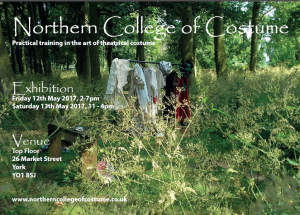
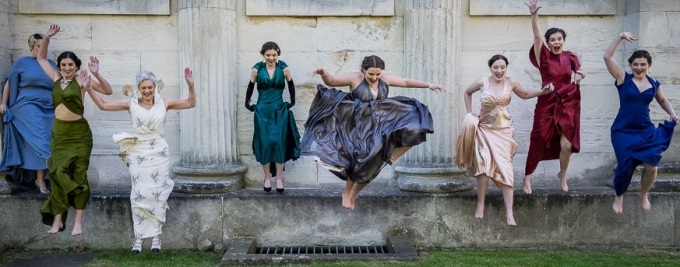
ncc flyerThink you are not interested? markterry_170509_8660cropThe latest group are putting their efforts on display this weekend and it is worth taking a look.
markterry_170509_8459crop
This is good old fashioned history based theatrical costume making.
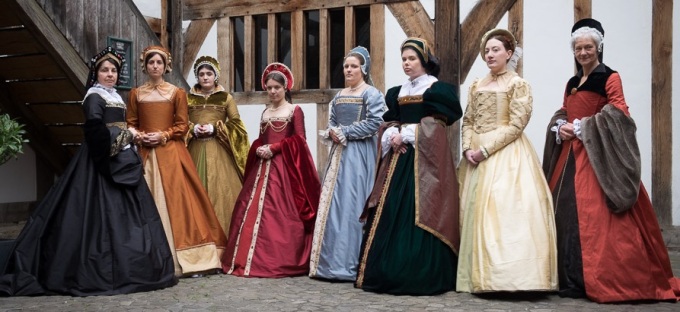
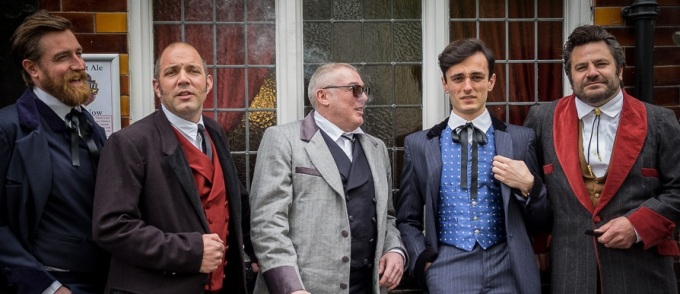
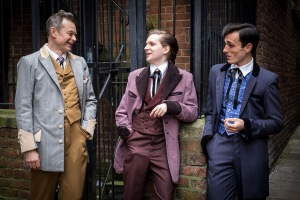
Never wondered how many component parts go into making one Tudor "dress"?  Well, now is the time to start wondering and also have the opportunity to find out.  At the same time you could take a peek inside  a Teddy Boy's pockets, or ask the ladies about their 1940/50s evening wear.
markterry_170509_8814crop
I went along as a dresser for the Tudor photoshoot in our local Tudor Barley Hall. Those big skirts over farthingales and the stays can take quite a lot  effort to get on and then to manage. It was so atmospheric in there - I can't wait to see the photos.
The Teddy Boys stayed in the city centre down one of the seediest side lanes. No romantic Tudor beams for them. The final shoot of the day was at a Neo Classical chapel. A rather busy day.
markterry_170509_8660
Take a look at the complexities of the makes, see what can be achieved with some  ingenuity, hard work  and a lot of know-how and guidance. And then think - this was all achieved in 15 weeks!
I did the course a few years ago, and survived with battered, stitched fingerends and a lot more skills than I started with.
If you are in York, do drop in.
markterry_170509_9194cropallPhotos : Mark Terry

Monday, 6 February 2017

A Tangent- but still costume and history based!

I spent part of the Autumn exploring the idea of clothing and words being linked at very particular times. This developed in response to my father's illness and the desire to wrap him the words he couldn't hear us say, to tuck them into the creases, seams and pockets of his pyjamas for him to find and hang onto as he woke up.
This became a textile installation  currently on exhibition in York, but also lead to other ideas.

What would result from combining primary sources with appropriate costume ?  One way to find out.


 Finding documents written by the mill workers proved difficult so contemporary  documents arising from their lives - a newspaper report and official factory accident report had to do as start points for the experiment.


National Archives is a great place to get lost in, virtually and really, but the first find was a newspaper report following an inquest  in Bristol 1860 on Elizabeth Davis, a 16 year old textile mill worker. She been injured at work and later died.

 The mill and the area was quite well documented with photographs from the era, so these were the start point for a simple work dress loosely based on a quarter scale version of a day dress in Janet Arnold's Patterns of Fashion. The account of the accident was embroidered across the bodice and around the skirt.


Martha Appleton was the small dress, 18cm high, and around the hem are quotations from her accident report. She had been injured at work, losing fingers on her left hand.


Made of cotton lawn to keep them delicate and light,  they were dipped in glue to set it into 3 dimensions. Martha was dip dyed but Elizabeth has been rubbed with graphite powder to age  them.

I still haven't made my mind up about them. There are things I would change, scale, the lettering, complexity of the make, but they are also in the exhibition along with extracts from the documentation. The initial responses have been very positive, even emotional.......

Thursday, 25 February 2016

A Victorian inspired Return!

Long time, no write, but it seems that the technical issues have been resolved. Well, we can hope!

This is one of the costumes made since the last blog. It is  a little Victorian walking ensemble of short tailed jacket, apron and asymmetrical  back overskirt over a polonaise  style skirt. It was made to fit the cat so some proportions may be rather odd! It is based on a V&A 1868 promenade dress, drawn by Janet Arnold in Patterns of Fashion 2 ,but as the over all length is  9", the jacket is 3", many  modifications have had to be made.
The jacket has a hook and eye closure underneath the fake buttons, but all of the shapes  and seaming
of the bodice and skirt panels  are as faithful as possible.  The elaborate cuff treatments were an adaptation due to scale  but I hope it kept the  idea of the original= they were certainly menace to do - I do need smaller pins and smaller fingers  too.  The flaps at the front of the jacket, collar and other decorative details were also sacrificed for reasons of sanity. The stand collar was borrowed from other extant jackets, it worked better with the cat  proto-doll.

The underskirt is drawn up on loops sewn into the seams to create the volume - the problem was always how to keep the hem level-ish and convincing. After all of the fiddling on the apron and rear panel I prefer it without. The fabric is too bold to carry the details, it becomes confusing. Another decision to regret was the inclusion of the premade roses - they look too mechanical and perfect. And of course there is the perennial cry about buttons - they may be the right diameter but they are too thick!  Some things never change.....


On a different note I am opening my work room as part of the York Open Studios event in April  2016- although the focus will be on my freehand landscapes these little costumes will be out and about - so come along if you want to see them or to chat!

Sunday, 13 July 2014

1830s Waistcoat Week!

This was the week for waistcoating... in fact it took far less time than this, minimum button therapy and only 2 icecreams.

Recap - 4th week of the course at the  Northern College of Costume, working from Ron Davis' pattern for an 1830s single breasted, shawl collar waistcoat. Patterns were drafted and toiles fitted. This now is the waistcoat proper....
From the toile the modifications were pretty straightforward, just lengthen at the waist  by 2 1/2" at the front and 1" at the back.

The fabric is a grey blue with a dull metallic broken pattern woven in. It is a kind of twill weave and manages to have very little substance - it's like that annoying friend who only says 'I'll do whatever you want to do' or 'I'll have what ever you are having' and then looks miserable for the rest of the day. The lining is a dull, dark duck egg blue, heavier and more substantial but reverts to floss when it frays. I imagine that any natural fibre content was purely accidental.

The fabric was cut and flat lined with a light calico and interfaced on the front and collar pieces.
front - with pocket!
inside front - facing and lining
After flat tacking to mark the key lines assembly began. Initially it is very clear - pockets (perhaps I should admit to pocket traumas - working out how to set them on the slant and how to minimise bulk, distressingly simple once the penny had dropped),  sew the centre backs to make complete back units, attach collar piece to front, collar facing to front lining, and join fronts to backs at side seams.  From this point on life gets more complicated.


side seams done - looks like bat sign


 I have never yet found the definitive simple way of putting a waistcoat and lining together, it seems I am not alone. This time we  placed rightsides together and sewed  around the armholes, front edge and front hem line. This meant that it could  still be turned rightside out.  The top 1/3 of the front
edge was left open so that we could get in  to sew the front shoulder to the 2 backs on machine ( The front lining would be turned under on the shoulder seam to hide all of the raw edges later on). 
Think the bit in the middle
 is the shoulder seam!
The under collar's centre back  seam was joined  and then it was  sewn to the  neck line. The top parts of the collar were sewn at the centre back and then the
centre back joined and sewn
 in place along neck line
front edge seam completed all the way round.  It did get confusing but was nowhere as fiddly as I thought but..... nothing can ever be that easy - we had misread the pattern a little and the facing  did not match to the shoulder seam - emergency surgery was required and with the help of the new best friend, Fray Check, disaster was averted.  Closing the remaining shoulder
back inside - the horizontal seam is the collar edge
seams and closing the last part of the neck by hand calmed the tattered nerves a little and it was on to the final stages.

The back has two layers so the hem allowance was folded up inside ( thanks to interfacing for helping to create a nice firm edge to sew along)  and hand sewn closed. Then key hole style button holes. By hand. All of them.
 Ok, did cheat a little- zigzagged down each side, punched the round edge and fray checked it before hand stitching. These are something to be practiced, and practiced, and then practiced again.

 Add the buttons, eyelets and attach the tabs ( still need ties) and it is all done - one complete waistcoat.


Distractions- let out to play with power tools - refixing Pauline's eyelet punch to its tabletop - starting to look for work placements for after the course, and creating a monument to Wednesday to keep those malevolent midweek spirits appeased.
Thursday was a part day  so did I sit in the garden reading, rescue pets in the on line games, clean the house? Yes, but also made a  waistcoat for Gwen. Went from  drafting all the way through construction.  How sad. But that emergency surgery on the facing had rankled, I needed to work this through and make it happen. Understanding the mistake did make life easier. Instead of days it was completed that same evening apart from the tabs. The fit is good considering  Gwen is definitely female - the back waist is too large and I had to put in front darts but it has worked! Not bad for a 50p upholstery sample and some left over pink and dotty cotton.  May be a bit too much frill on that shirt?


Coats next.......


Sunday, 27 April 2014

Georgian Jacket, caraco, pet en l'air, bodice......

Georgian Jacket - the French Revolution  Dress crossed with the Chocolate Girl.

Somewhere along the way I  acquired a pack from the Northern Society of Costume and Textiles about a dress  displayed at Castle Howard in the 90s.  The linen dress had been worn ( as a disguise!) by the widow of the Comte Guillaume de Panthou, wife of Henry Seymour, to escape from Paris at the time of the Revolution. By that time it was second/third hand, owned by the wife of a Seine boatman, adapted and altered from earlier incarnations. Although fine linen, it was no longer an expensive or luxurious garment, the fabric dates probably from the 1720s and this was at least its third makeover.

It was the bodice that interested me, the short body, fitted back, and the sleeve. The pack contained a gridded pattern to enlarge and detail drawings with notes. This was to be a quick slap it together at Gwen scale to see if this was something I would want to make for myself.  An hour later it was done in the rough and I was making a smarter version for Gwen  as part of her anachronistic pillowcase-wardrobe-in-the-making ( see the Victorian bustle dress). Never can keep things simple.....

As this was a reworked dress for a working woman how fashionable would it have been? Would it have been up to the minute? Was the style exactly what was desired or, like me,  would compromises have been made?  The photo above was the only one I could find for the dress so went looking for other sources for ideas of the front and closer detail on the peplum.  Many do seem to have similar bodies but  vary in skirt, sleeves and neckline. These source images and others are on my pet en l'air pinterest board.
 In the Liotard pastel study, the Chocolate Girl, 1744/5,  the jacket is different in detail, winged cuffs, the longer peplum reads almost as coat tails, and it looks as if the front maybe gathered under the apron bib. What it does have is a flat front with the shoulders  set well back, all  of the in and out curves on the torso happen at the back.
 I decided to take elements from both with a little bit of help from others such as the yellow c1750s example from Christies. This was never meant to be a precise recreation or totally historically accurate so a bit of mix and match wouldn't hurt.


The idea really was to make a short jacket/bodice  with a flirty peplum. The  fabric of choice was another Hobbs pillowcase- nice crisp cotton with a bold blobbish design.  The plan was to unpick and use the short side for the bodice and the larger part for the skirt. The base pattern shapes are from the Revolution dress but unfortunately the peplum was a greedy thing so I ran out of fabric to do the 2 part long sleeves - the compromise was to 'borrow'  a shorter single shape from Janet Arnold.

This is now complete, flat lined and with a contrast binding to finish the cuff and hem ( only because of fabric shortage- couldn't make my own bias).  It behaved quite well, apart from the fraying fine calico as the lining, but it did take forever. The back and peplum are in 4 pieces, the front and shoulder in 2 as well, so lots of  seams and finishing. In trying to speed this up I tried a stitching the top and lining fabric at the same time - http://stay-ingalive.blogspot.co.uk/2011/03/how-to-do-weird-running-whip-stitch.html . This seems to be a form of ladder stitch now I look at it but I ended up producing a version  of this. I whipped the return stitch over the top instead of coming back through the fabrics but it does work effectively enough.  I, of course, didn't remember about this until most of it was done.  The compromise sleeves look quite at home, the tuck at the cuff to create the elbow bend was a nice touch. The peplum is a bit exuberant, flirty I wanted but this is very outgoing, very 'pet en l'air'.


This is the first part of the outfit. Of course it needs the skirt. I borrowed my pet en l'air's skirt for the photos but it will need to be  slightly longer at the back to compensate for a bigger bum roll. The Christie's side view has a very exaggerated  bum, the peplum sticks out  above the horizontal. I think a  little less would suit Gwen, but will have to balance the peplum.  I'm hoping this style will suit Gwen's body shape more than the white pelisse - already she looks to be  more slender, the change in angle at the waist flatters.

 By next week this should be done, and hopefully the illustrations to go with it.  (It is going to have to be a Liotard-ish - but what on the tray? Chocolate.... cake? Coffee and walnut? TV dinner?.....)  or maybe match the starker style of the Victorian bustle dress?


pattern source - NSCT pack 2.- A Dress of the Revolution- worn for escape- 1793.  http://www.nsct.org.uk/
Janet Arnold,  Patterns of Fashion 1, p 42 (sleeve)
Met Museum and V&A


Sunday, 20 April 2014

white pelisse


Of  lovely April days, invasion of cat,  white pelisse, and other many distractions. This is the blog as it was meant to be!


Last week-

The making of the white pelisse-

The sun has shone, the grass and weeds are happy. The bees buzz, there are butterflies, the garden is in its purple Spring phase.  I might have been distracted from costuming but I have been refining copies and interpretations of fashion plates to show the latest additions to Gwendoline's wardrobe as well as constructing 18th Century items for myself, so it has been busy.

I decided to use a clingfilm  base and made Gwendoline a masking tape shell. This was sectioned into pattern parts and then cut and flattened to create templates- and it worked! There is very little gaping, or bowing, or pinching – all without any fiddling, adjusting or cheating in any way. Umm, wow. Don't worry, it won't last.


This of course has lead to unwise decisions, there is no point having patterns that will only fit once, I wanted to find out how flexible this approach would  let me be – 1820s shapes- lower waist, broader shoulders, exaggerated sleeves and decoration. The fabric is curtain offcuts – trying to look like a heavy weave cotton or linen but I'm thinking that the closest this has come to nature was being sat on by an invading cat. ( I yelled, it went from snooze to panic in one move, did a complete circuit of the kitchen tops and windowsills at full pelt before escaping out the backdoor, fled through the hedge and off down the road.... leaving me with hairy fabric and chaos!)

 One idea arising from the gingham frock (last week) was using the smocking as a substitute/sculptural form of gathering, so set out to try a Juliet style sleeve with the repeated gathered bands down the arm. I also wanted to do more with pleating on the bodice. Even my favourite pelisse has gathers above and below the waistline. This fabric is quite stiff, it will bend and flex but goes clumpy and lumpy on curves and bulks up very quickly. The pleats in the back look good but have left the waist heavy, a wider waistband than originally planned might be needed or else the waistline is going to end up the thickest part of the whole garment!
last week's progress


Having faith in the pattern pieces makes such a difference – and saved so much time. No repeat fittings, unpicking and realigning. Getting from 'what shall I do now?' to having a believable bodice took less than an hour. The smocking took about the same. If I had a brain I would have done the smocking before making up and attaching the sleeve. But the sleeve was a bit of a guess, I knew I wanted more fullness at the back rather than the front, and that Pingu arms must be avoided. So I began with a basic gathered sleeve shape and made the curve at the top steeper and off centre . It did take some minor fiddling as the fabric protested about curves but it sits reasonably well, although many sins may be lost in the puffiness. And of course the piece I cut as a pattern is now firmly attached !.
 

This week-
Overall the pelisse has worked quite well- the good times did not last  The collar was a problem, it still tries to stick straight out rather than relaxing on the shoulder. Repeated washing did not help it, the fabric has a great deal of 'boing' - it tries to reset itself to flat each time. The radial  pin tucks have helped  a little and something to experiment with later on. Fears about the waist at the back were well founded, it is thick and seriously needs stiffening. Perhaps come at it from the end - put a bow on the  waistband cb so the bulk becomes deliberate ( see little blue example above).
  I do wish this stuff would make its mind up - it bends when I don't want it to and is too stiff when I want it to bend.

 As a relatively plain pelisse it is fine, the gathers in the sleeves give it more character and style. The gathering on the centre back  should perhaps only be attempted with finer cloth. Poor Gwen does not look terribly happy it. It does nothing for her figure - the extra bulk on the waist is not good , there is nothing voluptuous or even jelly-on-a-plate-ish about her to give definition, she ends up looking like a tree trunk. In the plates above, the waist is so narrow in comparison to the shoulder/ sleeve line, and  Gwen goes in just a little and out not a lot. I do wonder about making her a set of stays /padded bodice-  can't pull her in but might be able to push her out. ( I'm sure I thought this before sometime - a little set of transitions with bust enhancer?)

One moment - repeated washing?  Knowing how much I enjoy domestic chores  you will have realised this had to be an emergency. Well, first the 'sharps' needle I was using was very sharp and I hadn't noticed, second time was due to creating drawings in pastels. The washing has caused problems, now the lining is not happy at the armhole, causing the wrinkling seen above, a bit of unpick and pull  will hopefully sort it but this garment will remain untouched until the pastel phase ends.

Distractions-
1. Pastels- not a medium I usually use but... apart from the dust .....they are quite fun.


2. The fake book. - it started with a charming photo posted on facebook from the Australian Jane Austen Festival in Canberra.  In the general flow of very learned conversation we decided the photo looked like a book cover, couldn't resist it, and....  Last time I caught up it was either Mr D would emerge a la wet shirt, or she had  just shoved him in.  The drawing took  over a morning and then working out the editing  programme took about the same. (Gimp2 - a free download, complex but very good)


3. Gave up putting it off and set up a website- AARGH.
 
  Pastels were easy, Gimp is straightforward. If I had known how to do this it would have been simple! Used Google sites, free, supposed to be an easy site builder, self hosting, and well I'm googled for almost everything else. Looking back, once the mind shift was made, it was straightforward enough.  Over riding the templates was the most frustrating thing - typing in black, size 12 in default font to find it published in blue, boxed in a corner and.......
Hopefully all sorted, hopefully,.... Feeling very exposed at the present.  Be warned - will have to start experimenting with promoting it next....
 
 
And totally recommend
BBCs   "At Home With The Georgians: A Man's Place. 
So much more than important people and oh look at the houses. Well done to Amanda Vickery.