Showing posts with label Wade Collection. Show all posts

Sunday, 30 March 2014

Regency shawl dress, Gwen shall go to the ball!

I claim no responsibility for this. A query was posted about using saris   to make a regency style ball gowns, they are a good source of fabric, richly decorated  and often excellent value. The responses cited the trend for dresses made out of the imported Kashmiri shawls in the early 1800s, something I'd known about but not really considered.
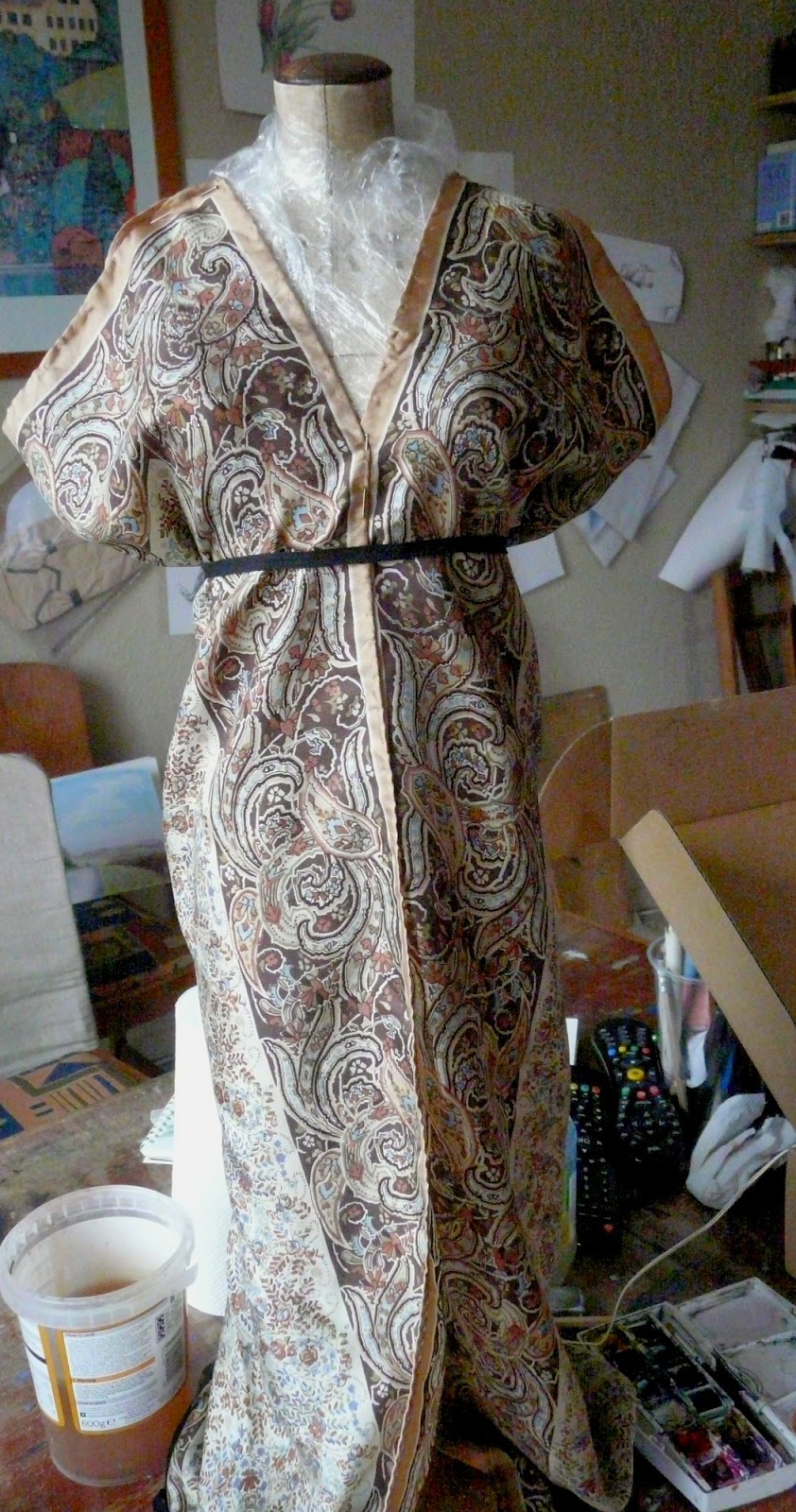
I just happened to be in a charity shop getting my breath back having cycled into town, it just happened to start raining so was reluctant to leave, there just happened to be a silk scarf of a sort of  Indian design, sort of the right size, so I bought it, and this happened......

Context first -  there are many pictorial and extant examples around, the shawls were huge so offered many options from the drapey Greek style chiton approach to using as a standard dress length of fabric.  The fabrics varied as well, from fine cotton and silks to heavier winter weight wool. The first blue dress was the one that began this little episode, from the Snowshill Wade collection dated 1815 and documented by Nancy Bradbury in "Costume in Detail". The second image is merely to show the volume of fabric and the ornate border of a shawl, the third is an 1810 dress from  Museo del Traje and  the blue print ensemble is  Empress Josephine's ( not entirely sure if this was made from shawl lengths or  fabric printed to look like it, one site is sure, another is not! but it has the same feel of using the imported pattern). They all make use of the borders and trims  especially around the hem and neck. The fashion plates show much the same  story but with more accessories, more ornament, layers of detail and pattern.
 
The original shawls were long rectangles with ornate ends but mine was a 30" silk-ish square with a printed border all the way round. A garment for me? No, remarkably draughty. A garment for the faithful Gwen. To the right the scarf is  folded into the centre and pinned at the shoulder to give a very basic drape. The challenge will be to stop it looking like a dressing gown. I like using the border  in the centre of an open dress but Gwen needs much more help and structure to give her shoulders, somewhere between the profiles of the  green and first red fashion plates.
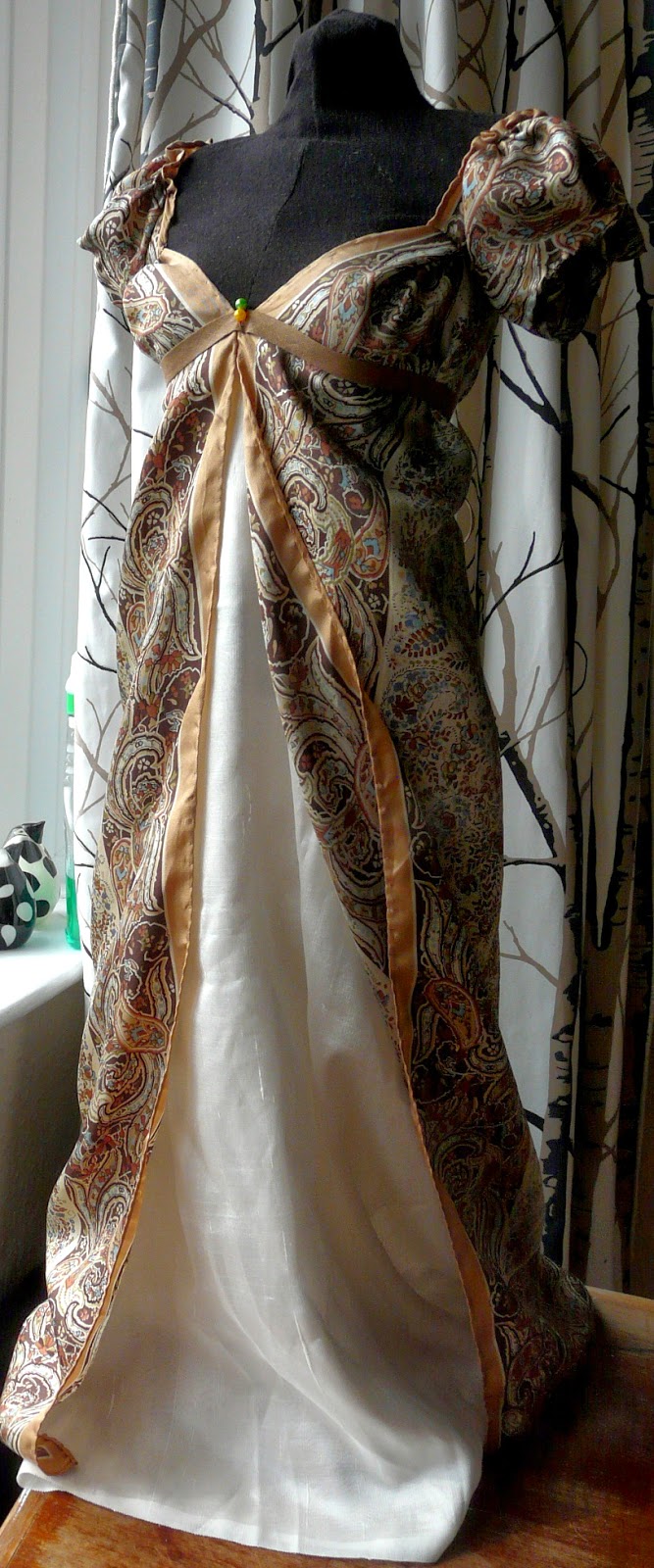
 The dress is fairly simple, the only cutting was to take off the top border, This reduced the length and gave something to make the sleeves out of!
 
There are 2 rows of gathering to create the bodice, on the high waist line all the way round from border to border and at the centre back along the top edge. The front is joined at a point 3" down and the very top of the front border is pleated back onto itself to give the separation at the bodice.   Each sleeve is half of  the sacrificial top border, sewn into a tube for an inch and opened flat along the top of the dress and  attached. They are gathered at shoulder and cuff trying to give that extra breadth  across the top line. I did reserve some of the yellowy border to do the front trim but it has escaped at the moment, so a length of elderly bias binding is playing understudy for the photos. It gives better definition to the bust but is rather clumsy  tied at the back. If I can't find the renegade trim this is all I have left of the fabric to work with - wish me luck!
 
And the most important question of all - Does this make Gwen look less like Juno, athletic and wholesome, and more of a siren, has she achieved cleavage? 

Certainly like the wider shoulder, even if they had to have stuffing shoved (romantically) up the cover to stop the sleeve slipping off. The back is a bit too much, may be lose some gathering to the sides. For such a straight forward idea this has not ben easy. Getting one side to work was simple, getting the other to match was a pain. The fabric was lovely, to look at, but had no substance. It lost all shape and form unless it was on the model so that was how most of the sewing was done. If I was making this for real the seams would be taped and the bodice mounted onto a lining.  I must take a pattern from this and try with a more meaty fabric, with some adjustment this could become another Gwen wardrobe staple. At least it is her very first grown up ball gown. Not bad for £2.49  ( cheap date).

Some useful sites-  There are loads out there, but will there ever be enough time to read them all?
http://historicalclothinganduniforms.blogspot.co.uk/2012/03/not-only-shawlshawl-dresses-and-dresses.html
http://thedreamstress.com/2013/01/the-kashmiri-shawl-and-the-dress-made-of-kashmir-shawls/

http://www.fashion-era.com/regency_fashion.htm
http://www.marquise.de/en/index.html

Sunday, 2 March 2014

Princess line bustle dress 1

Spent months being quite tasteful, there just had to be a backlash coming. When I turn nasty I like to do it good and hard - luke warm just won't do. So....

stuck to the recurring theme of the neck to hem long lines and pleating into the seams, and even a bit of polonaising and went Victorian!  Instead of en ferreauing I have been princess lining, not  Watteau pleats but a bustle!  Nothing by halves. While nowhere as ornate or complex as this dress

 from the Met, it will be a fitted, bodice front opening  down to below the hips. From there the front  skirt will be fairly straight but the back will increase in volume over a bustle cage and finish in a small train. I hope.

New things to do, new mistakes to make, exciting. Risking taking and problem solving - okay, on a small scale but still fun.

Back to Janet Arnold and Nancy Bradbury for a start point, again they both looked at the same day dress from the Snowshill collection.   Brightest  boldest candy stripes-
there is lack of stripiness in the fabric stash but lurking in the bottom drawer is a nest of Hobbs pillowcases - still in their packaging - desperate to get out. ( Not mad, bought when sold off as old stock, nice dramatic patterns, tight woven cotton. Only survived this long because I'd forgotten them)  Totally inappropriate. GOOD.


The whole of this has been done on the model, no pattern pieces, just a lot of pins, muttering, tacking and then redoing. Pattern pieces might have been easier.  The back - six panels, each full length with the centre and side panels  having extra width  from about bum level downwards to make pleats for the bustle bit. There is extra length on the centre pieces as well, this excess gathers up  in the side seams to make the polonaise. Again I like the idea of the contrast - fitted sleek v volume drama.


The basic ideas worked very well, worryingly so. The skirt bustled quite effectively and even began to train. It could have been an inch or two longer but there are plenty of opportunities to trim and extend. Getting the false front in was a bit of a menace - maybe that should have been done first and the whole front assembled then put to the back. I ended up starting from the centre back seam and building the dress forward from there. As usual focussed on the fun bit - working out how the skirt bustle came together.  I haven't got this too tight at the waist - there should be an internal waist band to hold the bodice in place which will help. As this was done as an experiment there is no lining either which would have helped avoid the stretching and twisting in some parts of the back.
The front of the dress has a false front  with hook and eye fastening on the centre line. Fabric choice was interesting - there was some heavy black satin all lined up, or another pillowcase - same colours tighter designs- or plain green or.... and I chose this Indonesian cloth. It was late at night, but having tried it all the rest looked safe and predictable. Not a wise choice as it had to be interfaced before it would hold the opening. Sometimes I like it other times it is sink into deep despair but unless something drastic happens it will be staying.  The collar is of the same contrast fabric, as will be the cuffs. There should be pleated inserts along the hem  - giving weight and flare I suppose- they may end up green and blue.


The sleeves are more tailored and shaped than the previous ones - in 2 parts and cut with curving seams. The sleeve head seems very shallow.
I did try a mock up of these and we are back to Pingu wings, flapping in the breeze. These current ones are cut with a steeper curve  but are still a bit flappy. The 18thC ones had lead weights but I haven't seen any reference to similar tricks for this. 


This is still very much under construction - final fit, finishing and trimming to do, all the fiddly bits, but it is looking better than I expected. I have enjoyed using the mad fabric choices - it is unexpected and instead of sitting there primly  saying 'aren't I historical', something else is going on. I will  have to do some thing to the front edges - the transition jars- a length of black grosgrain ribbon came off the pillowcase when it was dismantled - could be very useful.
It is starting to remind me of Yinka Shonibare's fabulous work but without any claim to be discussing cross culture references etc.

I had hoped to be finished by today - excuses are rather thin - keep falling asleep but did take a day out to join in with the Woolly Bike project with Cassandra Kilbride.  We were doing a Viking inspired bike as part of the Yorkshire Festival celebration of  the Grand Depart of the Tour de France this summer.  Very silly - I crocheted curly waves and half a snake. Di stole the show with a longship saddle cover and beard for the handlebars. The final exhibition with all 10 creations will be worth seeing!

Sunday, 8 December 2013

Gwen travels back in time -

Considering that I was interested in Regency costume  pet en l'airs and now a caraco are an aberration. These jackets were common wear in the mid 18th century but were sadly outmoded by the turn of the century when the Neo Classical was all the rage.  Mine was based on the example from Snowshill again used by Janet Arnold and Nancy Bradbury. It is not a complicated design = no shaping to the front, the underarm seam is a dart  and the back  panel is cut in 2 with the pleats in the skirt following down from the seams, a gusset giving extra fullness at the base of the underarm dart. The cuffs are lined and winged. Simple! 
I'm sure it should have been but again the pattern had to be Gwenned. I should be good at this by now! I am beginning to believe more firmly in the need for a basic block pattern for each era rather than scaling up from the original each time. Perhaps by next post I will believe strongly enough to have done something about it.
It was good to be doing a tailored back, even though I had to piece the fabric to make the 2 centre back panels. The extra seams are at the waist so do not look out of place. Understanding the fit was a problem. The National Trust photographs the garment as an artefact rather than a piece of clothing  and each of the other extant examples I found seem to be variations on a theme! Some were very much more intricate, shorter, longer, decorated and plain, some, en ferreau, some sack backed and others tailored! I was as faithful to the original as possible but don't think I got the underarm dart right. This became a seam and is too upright  you can see the pull to the bust, it should be angled  forward from the arm hole which would move the gusset  more to the front.

loved the back details and naturally flirty skirt!
 The flare on the skirt has had tantrums, the top and lining fabrics argued, especially at the gusset ( the triangular insert over the hip). A lot worked out when I gave Gwen real hip rolls. The pleats immediately became flirty rather than droopy!  The real pain has been the front neck line, the angle to the shoulder wasn't quite right  and it has a tendency to gape just a little. Neither the lining nor the top did this but together they made trouble. The sleeves were inspired by this poor behaviour - these are fitting no. 4. They are in and sewn and I don't intend there to be no.5.  
I had thought it would be longer from the illustrations in Patterns of Fashion,  but then I wouldn't have been able to fit it on the remnant of fabric at all. The proportions look awkward - I did have to redraw the waist lower by about an inch, so there is more body than skirt compared to the original. ( don't think anyone will know if I don't tell them)The winged cuffs were also a new thing and quite fun to do. It is a lined tube, pleated on the front and then sewn to the sleeve. The cuff is wider than the sleeve which gives the 'wing'.  I had to do the top fabric in 2 parts so they are a little stiffer and more awkward than they should be.

Not entirely happy with this. I am expecting more now, very little margin of error allowed. The flat lined garments look much smoother at the seams and the fitting is easier. This was started as 2 garments and then joined at the front and neck and then the side dart put in holding the two together.


Snowshill caraco,  National Trust
met museum. Dutch.
The 2 extant garments provided the shapes and form I was aiming for. The Snowshill one was the inspiration right from the word go but the Met museum one showed a similar robe in the round. The neckline is scandalous, obviously (hopefully)  there was an undergarment or a well pinned kerchief to preserve some modestly (and prevent chest colds). The sleeves are a little longer, without cuffs, but  I tried to get them to hang in the same way.  It does have the gusset, similar problems under the arm. The skirt is longer and more shaped, the pleats give the back a bit of a kick but not to same degree as mine. Perhaps I should have pressed the pleats in more aggressively.


Distractions - Gwen2  the clone- resurfacing and tidying, Christmas decorations, drawing and painting. Now reading about the Fairfax family of York. Have also put my drawings and paintings of these costumes onto a page - tab is at the top -